Thursday, April 11, 2024
stashes as research methods in researching making
 I’m writing!!
As I planned the 2024 year, I set aside April and May to progress analysis and writing on the Ordinary Knitters research project. Since Ordinaryknitters began, I have been privileged to interview 43 people from 4 countries who knitted for a public project, collected over the last few years.
There are knitters who cared for their community by making Christmas angels. Other knitters cared for creation by knitting climate scarves, encouraged peace-stitches through “French knitting” peace loom installations or personalised their place through knitting remembrance poppies. Each person making as a way of connecting their Christian faith in public ways with the wider world.
To understand these experiences of making, I’m using reflexive thematic analysis. Reflexive thematic analysis values three things. First, the intuitions and interests of the researcher. Second, the unfolding nature of analysis. Third, the ways in which the particularity of one experience can illuminate the particularity of another experience.
 I see reflexive thematic analysis as a way of making. I’m sifting through a rich stash of wool. My stash is unique, shaped by the active role my interests and networks have played in gathering the wool. I compare balls of wool, believing that fresh and new connections can emerge as different colours and textures (interview quotes and stories) are laid alongside each other. As I make, the unique colours of each ball will remain. In all I do, gathering, comparing, knitting, my craft as a maker will be visible. Yet the whole will be greater than the individual parts.
Practically, I undertake reflexive thematic analysis not with an existing set of themes to look for. Rather, I read “reflexively.” I start with the first interview and read it noting what I think are key words (codes).
I try to cluster these key words (codes) around big ideas (themes). I read further interviews. As I do, I work in “pencil” (reflexively) because the key words (codes) and conversation (themes) shift as I read. The experience of one knitter invites more codes, or a reworking of a theme, to better cluster a range of unique experiences. These reflexive changes require me to reread the earlier interviews. As a result, experiences from a range of interview are informing the experiences of another interviews.
I track the shifts in reflexivity by using mind maps and tables. These make visible my unfolding analysis. The mindmaps and tables allow me to keep track of my decisions and reflect (reflexively) on my assumptions.
This approach, of reflexive thematic analysis – assumes that I as a researcher have an interest and a set of values (why else would I be asking for an interview) which I bring to the interview and the analysis. This approach assumes that naming my interests and the way I make decisions will decrease the chance of imposing my research agenda on those being interviewed. It also assumes that insights emerge over time, particularly as the uniqueness of each interview is brought into conversation with the uniqueness of other interviews.
I love the making of reflexive thematic analysis.
Wednesday, September 30, 2020
crafting of call in the knitted theologies-of-ordination series
Last year, during my sabbatical as part of my research into craftivism and knitted angels, I learnt to knit. It is one thing to research intellectually. It is quite another to research by actually making. It certainly locates me as a dependant learner, feeling helpless and needing instruction.
With the sabbatical ended and the journal article submitted (“When ‘#xmasangels’ tweet: a Reception Study of Craftivism as Christian Witness,” Ecclesial Practices 7 (2) 2020, (co-authored with Shannon Taylor)), I kept knitting. Another scarf, then a babies cardigan, then some fingerless gloves from re-found op shop wool.
With a week of holiday recently, I found myself knitting dishcloths. During the week, I was sitting with the emotions of my resignation as Principal of KCML. The sadness at the ending of my relationship with ordination formation, mixed with the release from a demanding role which was at such odds with the understandings by which I had been called. As I knitted, I found myself thinking back over a decade of teaching and leading in the forming of ministers, beginning in the Uniting Church in Australia, followed by the Presbyterian Church of Aotearoa.
In the Uniting Church, when deacons are ordained, they are given a gift of a towel (along with a Bible, water, bread and wine), to indicate the diaconal call to a ministry of service.
A group of people, representing those amongst whom the minister will serve, comes forward. They bring a Bible, and water, bread and wine, along with a bowl and towel. Other symbols related to the field of service may also be brought.
One of them says: We are the people of God. We bring the holy Bible, and water, and bread and wine as signs of the ministry to which you were ordained.
Another says: We are the people of God. We bring the symbols of our common life and service.
The minister takes the Bible, opens it and places it on the lectern or pulpit; takes the jug and pours water into the font; and takes the bread and wine and places them on the communion table. S/he then takes the bowl and towel and any other symbol/s and places them in front of the communion table.
As I knitted, I realised that dishclothes offered a similar symbol. I was “hand-making” a symbol of service, that embodied the call to mission and ministry.
So began the knitted theologies of ordination series! Dishclothes, each of which speak to theologies of call to mission and ministry.
First, co-mission.

Knitted dishcloths as a symbol of ordination as a service of Christ; the colours an affirmation of the creative humanity upon which the Spirit of Christ falls and by which service to Christ is made/woven into the church in mission. Three colours to demonstrate the three strands of word (teach), sacrament (baptise) and discipling (make disciples) by which the co-mission (with other disciples) of Jesus (Go into all the world) is fulfilled (working with the wonderful work by Paul Avis, A Ministry Shaped by Mission
Second, formation.

A symbol of service. Handmade because every act of service in ministry and mission is handmade – is “truth through personality.” In the making of this dishcloth a blemish was discovered – a strand so thin the wool needed to be broken. Despite this blemish, the knitting continued. Such is the call of God, weaving human brokenness into a tapestry of love. Indeed as I knit, it becomes clear who this gift is for.
Third, ending.

Casting off is required for completion. Repetitive stitches, knit two then pull one over. So close, yet more care is required. My stubby little fingers struggling to pull one stitch over another. A theology of ending – repetition, patience, trying not to rush, little human fingers requiring kindness. Ending a ministry of service is unique work.
As I keep knitting, I hope to add to this series …
Friday, October 31, 2014
The complexity of authenticity in religious innovation: “alternative worship” and its appropriation as Fresh Expressions
There is a Cultures of Authenticity Symposium in Adelaide, 28 November, 2014. Here’s the brief
Authenticity pervades contemporary culture. This symposium provides a unique opportunity to investigate the significance of authenticity in regards to self, culture and society across key areas of social life from ethics, spirituality, work and intimacy to new media, tourism, health and environment.
The invite is to scholars to submit papers assessing the role of authenticity in late-modern life and its real-world applications and consequences. Full papers will be published in the journal M/C. It seemed a good opportunity to take my research on fresh expressions into a wider conversation, so last night I submitted an abstract:
The complexity of authenticity in religious innovation: “alternative worship” and its appropriation as Fresh Expressions
This paper will explore the formational potential of authenticity in late-modern cultures, with particular attention to unintended consequent complexities as authenticity is appropriated by contemporary religious innovations.
Recently within Western Protestantism a range of new approaches to church and worship has developed. Ethnographic research into these religious communities (called “alternative worship”) shows that authenticity was a generative word, used by these community to define themselves as marginal and thus to justify innovation.
However these acts of self-location, so essential for innovation and identity, were complexified when appropriated by the mainstream. This occurred first as mainstream religious communities sought to implement selected liturgical innovations generated by these “alternative worship” groups. Secondly, an organisation structure (called Fresh Expressions) was formed by appropriating the innovation. However the generative energy was not around marginality but rather on the renewal of existing institutional life.
These complexities can be theorised using the work of Sarah Thornton (Club Cultures: Music, Media, and Subcultural Capital (Music Culture)
This suggests that authenticity plays a complex role in identity formation in a branded world.
Saturday, November 16, 2013
faith development of women pioneers
If I had time, if I had money …
I’d like to do a research project exploring the faith development of women pioneers in not-for profit projects, who are motivated by a specifically Christian outlook. It would conduct qualitative research into women who exercise leadership in three contexts – larger evangelical/charismatic churches, ecclesial pioneering contexts and not-for profit projects – comparing and contrast the processes by which they develop their leadership, the impact of their situatedness in context, and the implications for their faith and spiritual development.
Anyone want to join me? More importantly, anyone want to fund the data gathering?
Monday, June 18, 2012
living in cultures of change
Spotlight, a leading national craft and curtain shop, sells raffia. This simple fact is important for local indigenous expression.
Yesterday Team Taylor enjoyed the annual open day at the Warriparinga Living Kaurna Cultural centre. We enjoyed the live music, watched the kids play a traditional game, kicking around a possum skin (yep, possum) and joined the local basket weavers.
As we chatted we learned that traditionally basket used reeds and grasses. However such things disappear in modern industrial cities. Either the practice of basket weaving dies. Or else the cultural adapts.
Hence the importance of raffia from Spotlight.
It reminded me of a conversation a few weeks ago. I was wine tasting and some older folk were chatting beside about the impact of technology. Will our children be able to read and write, in an age of screens and e-readers? They were concerned about cultural death.
I pointed out that my children are reading more widely and broadly as a result of the purchase of Kindle’s. To which they shrugged, sighed and said “I guess you’ve got to just so with the times.”
The resignation in their voices, the words they use, were very similar to what I hear in church circles. It suddenly occurred to me that
One, responding to change is not just an issue for the church, but for all cultures. It is a shared human challenge.
Two, that avoidance or assimilation, fighting or acceptance, are two very limited responses.
Three, that Christians who think about culture-making, about a variety of practices by which to live in change, that the adaptive resources from within indigenous cultures, are a helpful resource for living in change – not just for the church, but for all humans in modern society.
Friday, April 03, 2009
yes to bible and popular culture new book
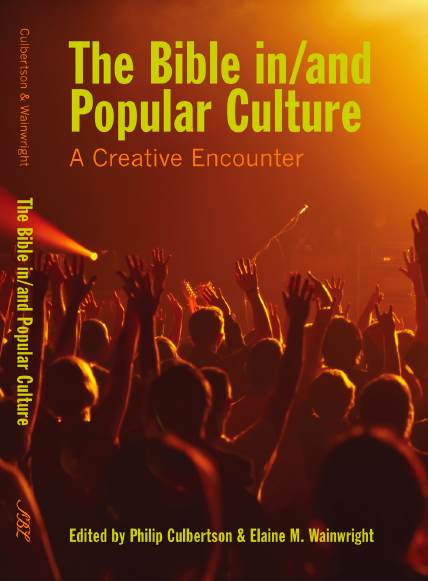
Semeia Studies is one of the leading, cutting edge experimental publishers in the area of Biblical studies. The editorial board has just said yes to a new book proposal: titled The Bible in/and Popular Culture: A Creative Encounter. Edited by Dr. Philip Culbertson and Dr. Elaine Wainwright the book will explore a wide range of popular media: popular music, graphic novels, fiction, television and video games. Particular attention will be given to the way these media engage biblical texts and characters and to hermeneutical and methodological/theoretical issues.
I post this because the book will include a chapter by me, titled: Reading “pop-wise”: the very fine art of “making do” when reading the Bible in bro’Town. So over the last few months, I’ve been quietly stealing time to move between the book of Revelation, Sionerella bro’Town episode and Understanding Comics: The Invisible Art
What I found intriguing was that so many of the issues discussed in Understanding Comics: The Invisible Art
Saturday, June 24, 2006
the context of storytelling
Stories are the stuff of human experience. Yet all stories have a context.
Tell us a story. Tell us about your church. Blog reading. Book reading.
All these questions and activities require some sort of ability to understand both story and the context in which it emerges. When you hear my story (read this blog, ask me a question) to truly understand, you need to be able to place story within context. You also need to be aware that in reading and asking, you are bringing your assumptions about life and church and emerging church and life to the table.
The emerging church suffers from this. People make photocopies rather than re-contextualise the contextualisation. The emerging church seems (IMHO) to be a shared conversation among people, groups and churches, about life and faith in a changing contemporary context. But it is so easy to objectify the stories and to read the conversation as monolithic, as “this is the emerging church.” In doing so, the stories have been stripped of context. They are then in danger of commodification, as books, websites, podcasts etc.
This week I have been a a storyteller in a new context. This has focused for me what has been a recurring question; Does this task of contextualisation belong to the reader/listener or to the communicator? Are there ways to tell stories, or frame stories, that allow context to be laid alongside story?
Saturday, February 21, 2004
this quote goes out to my auckland church and society class
Engage with communities and the new generation of consumers or risk losing market share. Full BBC article here.
Monday, February 09, 2004
consume the body
jez commented “the biggest pity is that Borders is such a bad model if you’re concerned about justice, muliplicity and diversity or the local and the specific. I won’t bleat on about Borders’ purchasing policies nor about the impact of Borders on small business and local community but whatever Borders might be it is hardly the kind of organic, local, just community i’m looking for to nourish my spirit”
We all consume. We can’t live without consumption. Some then become aware of the impact of their consuming on the third world, on the local, on the diverse. But we are all still enmeshed in a web of consumption. We need a third way, a theology of consumer resistance.
We need the 10 commandments of a healthy consumption
consume no logo
consume fair trade
consume adbusters
consume organic
consume no meat
consume shade coffee
consume 5 loaves, 2 fish and have 12 bags of waste
consume the body of Christ …
Monday, February 02, 2004
stone in my shoe
One of the big arguments of my PhD, and of the book I am working on for emergentYS, is that people “make do”; that in the face of cultural change, people are creative, transformative, adapting the bits from the world around them to create their own unique mixes. It is based on the work of French Jesuit Michel de Certeau.
The only flaw in the argument is this article on the disappearance of languages from around the world, via they blinked
How many languages have disappeared in the last century? About 60 or 70 per cent of linguistic diversity in the north-western region of Brazil has gone in the last 100 years. On the Atlantic coast of Brazil it’s worse – about 99 per cent – and around the world the figure is 60 to 70 per cent. It has been very rapid.
Being brought up in Papua New Guinea, a country of over 600 languages, the loss of even one language saddens me.


 )
)