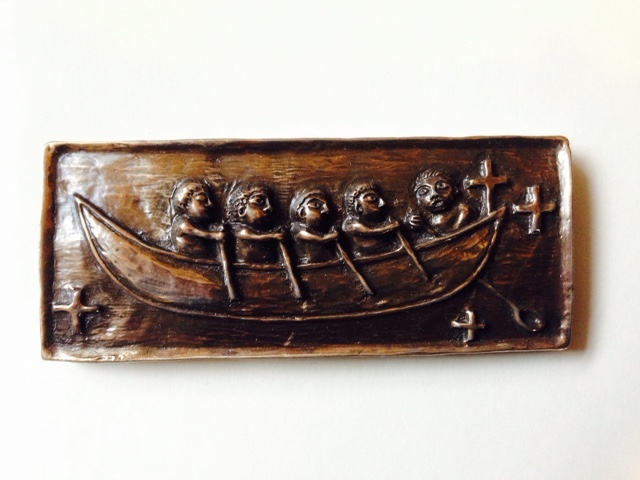
June 13, 2008

soak and space

soak400.jpg

We had an evaluation and planning meeting of our Soak service last nite. Soak is quite unlike any alternative worship thing I have been part of. It's got stations AND sung worship. It's in the main church that is beautifully lit with candles and draped with fabric. Which works stunningly well in creating a very rich space. We try to avoid theme-based stations, instead offering regular communion, confession and journalling stations, which lessens the intense creativity usually demanded by alternative worship.

Soak happens monthly on the first Sunday of the month. It starts with sung worship for about 30 minutes. It then offers a lectio divino Bible reading for about 15 minutes. The various stations are then introduced and people are invited to leave when they want to. A benediction is taped to the exit doors.

What this means is that Soak is what I, for lack of a better word, am calling an adult space. So much church spoon feeds you. Every minute is programmed and full. You are not required to do much. In contrast, at Soak, if you lack an inner world and don't want to work that inner world, you get bored pretty quick.

Here are some of the unexpected learnings:
- some (not all) of our teenage boys love it
- people stay so long, regularly over 2 hours
- it's genuinely redemptive with 2 people asking about baptism
- the Bible has been liberated, allowed to become a springboard for prayer rather than something to analytically dissect.

Posted by steve at 10:04 AM | Comments (1)

June 03, 2008

smash communion

Theme: colliding worlds

Call to worship: People were invited to write their names on coloured flowers, as a way of naming themselves as present in this act of worship.

Psalm of lament: on each table were placed dinner plates, colliding worlds (poor:rich or east:west or young:old) were written. People stood, read out their words, and smashed the plate. Yep. Smashed it. Some found this very therapeutic!

Response: The fragments were laid on a cross. People were invited to also place their flowers on the cross. It became a nice mix of colour and collision.

Benediction: The Message translation of Colossians 1:18-20 was read, followed by these words.

When I was in Gisborne over the summer
I collected lots of sea glass off the beach.

I reflected on Colossians 1
where it says that God will take
all the broken and dislocated pieces of the universe
and fit them together in vibrant harmonies.

Perhaps God will fit them together
in something new and mosaical
rather than simply using superglue
to stick all back together as it was.

And the invitation was given, to go into God's world and participate in mosaics.

One person was so moved, they took home all the broken pieces, dreaming of how they could create their own mosiac.

Posted by steve at 11:51 AM | Comments (1)

May 20, 2008

is singing rational?

"whenever we speak or sing, we switch into the side of our brain that’s largely rational and analytical, so if the worship / sacred space is taking us into a space beyond ourselves, the singing will often bring us back" Fascinating comment by Cheryl, whose blog regularly pushes my creativity.

But I'm not sure I agree. I think it depends on what words we say. And I think it depends on how the human voice is invited to participate. I think of poetry; words but neither rational nor analytical. I think of the naked human voice and the way it calls to something mysterious. I think of the raw beats of dub, and the way they move my guts.

A few years ago I asked a visual artist if I could include some spoken words, to be said over the top of their artwork. In their reply, they commented "Steve, you are using words to open things up, not close them down." It suggests that words need not be analytical.

One of Sinead O'Connor's CD's has a fascinating spoken word rant, extolling the power of the human voice, linking it with God's creative endeavours. It suggests that words and sung words need not be analytical.

It is an issue that I am really wrestling with. I am concerned about the individualism of much church practice and I suspect that the reason churches create consumers is because they offer consumer practices. I personally struggle with sung worship, but I have rationalised it (irony noted), because I suspect it preforms a non-rational element in worship. Equally, I struggle with the individualism of much station based alternative worship and again, sung worship does invite a corporate way of being. Equally, I object to singing a song which dictates how I should feel and respond to God (in contrast to songs which are about God and who God is).

We are in a major experimentation phase with our morning service. Being Pentecost, the time when the Spirit disturbs the church, we have invited some of our visual artists to disturb the auditorium.

We have curtained off the front with floor to ceiling cloth, which has been backlit (in red, the colour of Pentecost). We have moved the preaching place into the middle of the space and brought in sofas to create a more surround sound experience. We have hung 2 Pentecost art installations. And have worked up 3 video screens, enabling us to run video loops.

And we have argued. And we have taken the criticism. Is this corporate church? Will it distract? Is this a mess? Why are we doing this?

My intuition says we need layers. We need words that are both mysterious and rational, we need music and singing used in ways that are analytical and emotional, we need ways to be alone and together, we need both our head and our hearts to sit with art and colour and symbol.

Thanks Cheryl for keeping me thinking (for your gift of words that help me form words :))

Posted by steve at 09:59 AM | Comments (7)

March 29, 2008

evaluation multi-media in easter worship

Email from Jeremy Williams (UK Programme Development, SGM Lifewords): I've just been writing up a debrief on our Easter project, and I came across the mention of the films on your blog. Thanks for the link, and for the resulting traffic!

I'm going to be writing a short news item for our magazine too, and it would be great to include a quote from someone who has used the films on the ground. Can you tell me a bit about how you used the animations, and how they were received?

My response: Hi Jeremy,

We used 4 of them in 3 services:
Palm Sunday we used day 1 and day 3. Day 3 (breaking of Alabaster jar) was used to introduce the offering and gave a lovely texture and nuance. Day 1 was used to tell the Palm Sunday narrative by way of introduction.

Easter Friday we used day 6, at the end of the reading of John 18-19. It was a powerful way to underline the death of Jesus, helping hold the liturgical space that is needed as the death is pondered from multiple perspectives.

Easter Sunday we used Day 8, again by way of introduction early in the service and as a way of telling the narrative.

I used them because they gave visuals to Scripture. I liked the use of text+symbol+music+aural reading. It allowed Scripture to be multi-valent. One of our art students commented on the art techniques, she is using similar in her study, so there was a particular resonnace for her.

Good work and kudos to whoever was the creative catalyst and project manager.

Posted by steve at 10:42 AM | Comments (0)

March 11, 2008

so who is the Bible for?

As I continue to probe the place of the Bible in church today, I have found myself asking who is the Bible for? Is it for individuals or for the church?

Is the Bible for individuals? And therefore the way we use it reinforces this. We encourage personal devotion and applaud a sermon that applies the minds of the individual with thoughts and truths.

Is the Bible for the church? And therefore the way we use it reinforces this. We preach a sermon that applies to the church. We encourage devotions that remind us we are reading within a wider communion. And we read the Bible together in ways that invite the community to engage the text as a community, through practices like communal lectio divino, Dwelling in the Word, community discernment, storytelling, takeaway spirituality.

Or is it for someone/thing else? Am I making a false dichotomy? How much does the culture we grow up in shape our answers?

Posted by steve at 01:55 PM | Comments (8)

February 11, 2008

offering practices

One of the good gifts that Jason King, one of our pastoral team, gave to us last year was a re-shaping of our offering practices.

As we designed Grow, our new evening congregation, Jason suggested that when it comes to the offering, we give everyone a piece of paper and ask them to write down what they are offering God in the week ahead. (This works really well at Grow, because the service meets around tables. So it's easy to have pieces of paper and pens on each table, along with muffins and a range of other ways to participate.) Practically, this helps everyone to contribute, and avoid the embarrassment of only a few giving in a smaller congregation. Theologically, it reminds us that the offering is indeed about all of our lives, and not just our finances.

Personally, this simple change has radically transformed my sense of worship. As a person, I use automatic payments, so the offering bag has less connection. As a pastor, I attend three (of our five) congregations and even if I put cash in, it raises questions about which service I would do that at.

So the simple invitation to write down what I am offering, has allowed me to re-engage with the offering and to consider a meaningful contribution. I've written things like helping a community family move, work a long week for the church, enjoy a great day off. A very simple thing that has helped me connect my faith with my faith.

(Jason was with us as a Community Development Pastor for a three year period. This ended this month, and, in God's goodness to Jason, he was called to North Avon Baptist. Thanks Jason for the gift of the offering idea and God bless you as you start your ministry this week).

Posted by steve at 05:06 PM | Comments (0)

December 23, 2007

updated (with a womens voice): moving four advent candles

I have just reworked our use of the Advent candles, to try and capture the movement and journey that is inherent in the Old Testament narratives. As a church, we have just finished a series on the Minor prophets, so it also serves to tie that into our Christmas preparation. And to involve the children.

I quite like it, and the way it connects narrative, Bible, movement and symbol. You?

A video will play, From Adam to Jesus (downloaded from here); offering a visual layer.

The 4 Advent candles will be given to 4 groups standing at different places in our worship space. Each group will have an adult and kids. Each group will say the words below, then come forward holding unlit advent candle high, place it in the Advent candle stand and lit it.

Candle A:
In the beginning, before Adam
God allowed for chaos
And storm and troubled times and fear of the dark

Then, when all was formless and empty, God spoke, "Let there be light"
candle is lit

Candle B:
In the course of time, through Abraham and Moses
God allowed for a journey
From home comfort to a promised land
From familiar family to a new nation

Then, when the journey was hardest, God spoke, through burning bush and Mt Sinai. And there was light.
candle is lit

Candle C:
In the course of time
Through David and many kings
When power was misused and the way ahead unclear
When the covenant was broken
And the ancient wells ignored

Still God spoke, The LORD is my light and my salvation (Psalm 27:1).
candle is lit

Candle D:
In the course of time, through the prophets, minor and major
In collectors cards and stoning prophets
In the pain of broken promises and the hard times of exile

God spoke, "The people walking in darkness will see a great light;
those living in the land of deep darkness will see the light dawn." (Isa 9:2).
candle is lit

Updated - Another candle option: Replace any of the above with the following:
Down through time, through women brave and bold,
In the vulnerability of Tamar and the courage of Rahab
Because of the loyalty of Ruth and in the faith of Mary

God shone and the Spirit hovered and Mary conceived a son, "Who would save people from their sins." (Matt 1:21). Candle is lit

Posted by steve at 04:06 PM | Comments (5)

November 28, 2007

advent in 2007: updated

It's Advent, four weeks when the church starts to prepare for the Christ. It's probably my favourite season of the church year. This year our preparation as a church will include;

a) giving everyone a wee glass bead, one per week, with the words "hope", "joy", "peace", "love" glued onto their base. Beautiful enough to hold and tend, small enough to carry in one's pocket.

b) digging out the advent journals again (8 journals, each journal is numbered and different and released into the church community for the first week of Advent. When you get a journal, you have 3 days to write in it what preparing for Christmas means to you, and can then pass it on to anyone you like. If you have them on Sunday, you're invited to bring them along to be read in community).

c) using these short Advent videos.

d) offering a Blue Christmas worship experience, Wednesday, December 18, 7:30 pm, in the church foyer, for those who need to explore life's blues in the presence of a babe about to become a refugee.

e) using this on-line Advent calendar at family meal times. (Hat tip to Olive Drane aka Clown Barni.

Posted by steve at 09:22 PM | Comments (5)

June 03, 2007

a workers communion

workercommunion.jpg

As we move to communion, you will notice that it is being served on 3 working communion tables: a kitchen sink, a work bench and an office desk.

And so this table is not a Baptist table.
It's a workers table. It's for anyone who wants to remember.

So come Holy Spirit,
Help us remember that God is a worker,
Help us remember that Jesus was a carpenter,
Help us remember that when the bread was broken,
When Jesus said "This is my body, Take, eat, do this in memory of me, This cup means a new covenant in my blood, whenever you drink it, all of you"

Help us to remember that this meal of memory, this first communion, did not happen on a special table with a white lacey tablecloth.

But it happened on a kitchen table in an everyday house,

So come let's eat and drink, in memory of God the worker, at work in our lives, and at our everyday worktables.

Posted by steve at 02:37 PM | Comments (0)

June 02, 2007

trinity sunday worship

Christians worship God as Trinity. It's not an easy concept to ground. This has been made in preparation for our Sunday worship:

trinityworship.jpg

3 different Trinity art images;
accompanied by a brief explanation;
and a black band running continuously around the bottom.

Printed on a sheet of A4, on Sunday we will give them out and invite people to reflect on which one of the three images most connects them with the Trinity.

This will take some time, so we will add in some layers; including the images in colour rotating on PPT and music in the background (an upbeat version of Holy, Holy, Holy from Eucharist CD). Plus we will hand around biscuits - a cracker, a piece of cheese and a gerkin. (Idea sourced from our good friends, Tony and Jan). So if people have trouble getting your head around the Trinity, or interpreting the art images, well they can always just taste the trio, for 3 distinct, but together as one, is better than three alone.

Finally, the A4 sheet has a little tab at the end. So it can serve as a takehome - sellotaped together and can sit on a mantelpiece or desk top for the next few weeks, helping people continue to reflect on the Trinity.

Posted by steve at 02:32 PM | Comments (0)

April 26, 2007

so why can't those notices be worship huh?

I wrote the following email to some our ministry team on Tuesday. The background is that Sunday morning's service was needing to include a baby dedication, a report back on a short term mission trip, a (ideally monthly) local mission focus, and a (ideally monthly) prayer for workers in their workplace - alongside the notices and offering. So we were trying to integrate all these together. I went home, thinking about worship, and wrote the following:

hi team,

Still thinking about all the negotiations today about bits in the services. Here are some reflections
1 - It's a recurring theme over the last month.
2- It's a sign of health that we have babies to dedicate, mission trips to report, ministries to promote.
3 - A church service should never be one long infomercial, a but "wait, there's more ....."
4 - At the same time, it should be a time for the community of God to hear the stories and celebrate God among us during the week. This is worship not through song, but through the events of our everyday lives as an affirmation of God in all of our life.

So ....
what about if we worked at making more obvious that all the bits are in fact worship. They are not bits to be fitted in around songs, but are a healthy, vital part of our life that should get us going "praise God" (thanks) and "please God" (intercession).

So ....
what about we coin a regular part of Sunday. we call it say "community life." we expect it to take say 15 minutes each service. what about we create a clear opening (set prayer?, set visuals) and a clear closing (pastoral prayer? and Lords Prayer) and in between, each week, we put the bits -- the notices/offering/storytelling/red seat/etc etc.

what about if had an overall "leader" each week who were responsible to open and close and arrange the bits. they sit on the couch and interview people and pray. they ensure a mix of interview/video/ etc, so that it is not all talking heads. they are not the worship leader, and thus allow more participation and a different gift mix to be at work. the clear opening and closing allow the song worship leader to more smoothly integrate and link.

obviously it won't happen this sunday, but could this make the "bits" more themed, more creative, more integrated into our worship.

any thoughts?

Posted by steve at 12:06 PM | Comments (6)

April 08, 2007

he is risen indeed

palmsunday300.jpg It's Easter Sunday and this morning we sat in the Easter Garden, on sofas, and among the New Zealand native trees. Sparking grape juice in long stemmed wine glasses were passed around and people were invited to share the stories of life. It was very cool to sip the sparkling and listen to story after story, told among the people of God. We proposed toasts:
: to invited neighbours moved to tears by the Easter Journey,
: to fathers who play with their children,
: to the differently able we work with who are being re-integrated into the community
: to cleaning up garages and realising that
: it is Jesus who makes it possible to start again, and again, and again.

Over a 1,000 people walked the Easter Journey. Photos to follow.

Posted by steve at 01:42 PM | Comments (2)

April 01, 2007

what lurks in Jesus wallet

practice7forblog.jpg

This is the 7th, and last, of our Practising our faith series. (The 7 week series, with accompanying takehome resource and small group study guides, has worked really well). The Biblical text is Jesus entry to Jerusalem. The art image wonders what Jesus would have carried in his wallet? The practice is the invitation to empty one's wallet and consider what the contents reveal about one's priorities, relationships and values.

In response the symbols - chalk (black/white); coins; rock; nails; plumbline; flower; bulb - I wrote the following meditation (concept inspired from the Grace Lent blog):

Letter from God to Digestion Congregation

Hey there.
Whats up?
Long
Time
No
See.

I know I haven't been around much.
But it doesn't seem like you really wanted me

the first time I sent down a message,
I left you the beauty of creation,
My fingerprints in flowers, (flower)
My palm prints in bulbs, (bulb)

But you've done your best to spoil my garden,
Kill my creatures
Pollute my waterways.

The second time I sent my prophets,
men like Amos and Isaiah and Martin Luther King,
women like Deborah and Mother Teresa,

To hold up a plumbline of justice, (plumbline)
To measure your ways as straight,
To remind you of true worship.

No more choruses. Please.
Simply talk to those who feel left out,
Simply stick up for those who can't speak properly or think clearly.

But you chucked rocks (rock)
Stoned my servants, shot my saints,

Then I sent a personal message,
Up close and human,
a child and a carpenter,
a teacher and a healer,
a man named Jesus, God with us, God saves,
But you took 30 pieces of silver (coins)
and great big hunks of steel and nailed him to a cross. (nails)

That shook my world
Turned me dark, (dark chalk)
made me cry.

Finally I sent my Spirit,
To point to my creation
To remind you of my prophets
To shine light in dark places (light/black chalk)
To point you to Jesus
To form you into his body.

You called it church. Digestion.

So as you walk toward Easter this week,
Through Easter Journey and into Easter Camp.
I wonder what you will do with my message,
My creation, my prophets,
my Son, my Spirit
This Easter.

Posted by steve at 06:37 PM | Comments (2)

March 30, 2007

to do at easter if you are in christchurch

journey publicity280.jpg

Here is a higher resolution version if you would like to put up a poster in your church/workplace.

Posted by steve at 01:18 PM | Comments (1)

March 27, 2007

easter scattered

easterscattered250.jpg

From Opawa church newsletter:
As a pastor, I always struggle with Easter. It is the highpoint of the Christian year and one that I believe that all Christians should engage with. Yet it is the last holiday before winter and for those who work hard, an important time to re-create.

So, this year I am offering an Easter Bach Pack, a short Easter service that can be done by families and groups in a holiday home. It includes things to do and say and hear, and an activity which can be brought back to Opawa in the weeks after Easter. The service will be similar to that offered here at Opawa.

While this demands more from us as a pastoral team, we believe it is a concrete way of living out our vision for the year, from Ephesians 4:1-13, with the church as a resource that sends people into the world, rather than sucks them into a building. It will allow us, whether gathered or scattered, to maintain a sense of a shared Easter. (We are also wondering about offering this on the internet, so that people anywhere in the world could download the resource and use it.)

So, whether away or present, we are asking you to join with us in this high point of the Christian year. If you are going away for Easter, simply order an Easter Bach Pack (Friday or Sunday or both) from the office.

Note to blog readers: I had hoped to offer this as a resource over the internet, but Easter is simply coming too fast. Never mind. There's always next year.

Posted by steve at 02:57 PM | Comments (2)

March 16, 2007

lost and found worship

Sunday the text is Luke 15:1-9. A worship response is shaping up around 3 stations.

ONE: Community station - with pictures and explanation of the church's various community ministries and the invitation to

Look: at the pictures and explanation of the church's various community ministries

Reflect: by praying

Act: by saying yes to participating (including needing more Boys Brigade leaders, and involvement with our annual Easter Journey art installation).

TWO: Sheep station - with a metal fencing and gate, and the invitation to

Look: at the fence and the gates.

Act: by sitting inside the sheep pen.

Reflect: How would you feel if you were ninety-nine? Pray for us at Opawa, and for what your feelings mean for the future of the church.

THREE: Coin station - with a whole lot of coins scattered around and the invitation to

Look: at the art image, Woman Sweeping, by Jean Vuillard; which portrays God as an ordinary house-keeper in everyday life.

Reflect: on the following poem
I was passionate,
filled with longing,
I searced
far and wide
But the day
fhat the Truthful One
found me,
I was at home.
by Lal Ded

Act: by holding a coin. On one side of the coin is a name of a child in our community (either from Boys Brigade or Koru). Pray that they will be found.

The other side of the coin is blank. It might be your name. What does it mean for you to know that God, like the woman, searching is for you? It might be someone you know. You might want to pray for them by writing their name (permanent marker supplied).

Whatever you do, take the coin with you into your week.

Posted by steve at 03:00 PM | Comments (1)

March 13, 2007

updated: why lent?

Why Lent? "And so you can see why a lot of Reformers are not happy with the Emerging Church. After effectively getting rid of quite a number of meaningless rituals like Lent ... the emerging church seem to be undoing some of these gains. Don Carson describes the emerging church as a protest movement. Is it true? Are we protesting the protest? Are we rebelling against the Reformation or are we helping the church to reform again to regain its status as the one holy catholic church?" Tallskinnykiwi wrote

Both at my previous church, Graceway, and now at Opawa, I have introduced a focus on Lent. This year this has included the Lenten 7-pack Practising our faith - a takehome resource with art and text, studies for our small groups and introducing mid-week Lenten study group/s. So why does this shortstubbykiwi support lent?

1. Easter is too important: For Christians, Easter is the highpoint of the church year. An event anticipated is much more likely to be an event celebrated. I liken it to a birthday party - the use of an invitation is crucial for building anticipation. Practising Lent allows us to send invitations to, and among, our church community. It allows the community of God to build toward Easter.

2. Lent is a great time to focus on discipleship: In Lent, Jesus is walking toward Jerusalem. The use of Lent, (and Advent) allows us to focus on the following of Jesus in discipleship. Every year Lent allows us to pause and remind ourselves of Jesus taking up the cross. Lent is thus like grit in our shoe. It works against "cheap grace."

3. Lent allows us to accentuate the postive by building practises: I do not see Lent as time of denial, but as a time of building Christian practices. Here at Opawa we explore how Jesus lived (for example this year as part of the 7-pack Practising our faith we are focusing on his mission, his use of Scripture, who he ate with, who he included in his community, what his wallet said about his priorities). This has nothing to do with Don Carson's "protest" but about our passion to live as Jesus lived.

Update: 4 - A comment by John Hebenton: Steve talked about some Lenten material he has put together around good practices. I really liked this. It reminded of the Irish Penitentials, which were about developing the virtues rather than penance for the sin. I have tried to approach Lent in that spirit this year Instead of just giving up computer games, I have thought about what virtue I wanted to build by doing that – spending time with my children. Instead of just giving up swearing at bad drivers, I decided to build the virtue of praying for peace for those who annoy me (bad drivers) – I keep forgetting this one. It has made all those silly giving things up for Lent so much more meaningful."

Sorry tallskinny, I remain totally baffled about why a bunch of "Reformers" would be unhappy with my working with Lent as part of forming a community in the way of Jesus as revealed in the Biblical narrative of his walk toward the cross.

Posted by steve at 12:47 PM | Comments (5)

March 09, 2007

more lenten resources

A few weeks ago I highlighted some Lent and Holy Week resources. Here are two more:

Tears of lament: "The triumph of life takes place at the edge of death" Jacques Derrida
Running in Highgate, Dunedin, this church are using Lamentations as the basis for creating a "House of Sorrows." They are wanting people to post prayers and stories of the 'lament' in our present world. You are also welcome to send to them a small piece of cloth/rag, which will be placed in their church as part of the House of Sorrows; thus creating an installation that can give voice to lament and be a place for offering prayers of Hope. Sounds a fascinating mix of global prayer and installation and community.

liturgylogo1.jpg And there is some good thoughts on worship at this New Zealand liturgy site, along with suggested resources through the Church Year, especially useful for those who appreciate words well-used.

Posted by steve at 05:26 PM | Comments (1)

February 21, 2007

lenten resources

Some excellent Lenten resources floating around. Cityside Baptist are offering a digital prayer and art-making process.
desertfiles250.jpg Go to their website and you face four choices - a theme, a media, a prayer path, and a recording process. Resources are offered daily, including a Friday special in the form of a creative, lateral stimulus. A digital way of letting people individually create art and engage in prayer through the whole of Lent. Excellent.

Lenten 7-pack; practice1at250.jpg at Opawa (and other participating churches).

Urban seed have 40 creative readings in an attractive, wallet-sized format.

I have blogged in previous years about the personal Lenten value I have gained from 40x196.gif Si Smith's "40". It's a CD-Rom with a visual reflection on each of Christ's 40 days in the wilderness. It can be used for contemplating an image a day for individual preparation; it could be used as one of a number of worship stations; it could be used as a visual meditation in a more established church setting. (There's an e-interview with the creator here, and again, antipodean's can buy it from the future church nz website.

detox cover.jpg Peter Graystone's Detox your spiritual life in 40 days is a great travelling companion. Aimed at 20's-30's, it's a helpful mix of readings and action steps for each day of Lent. (And great to see that it is coming out in the US, as I have been asked to provide a review for promotional purposes).

lentscifi.jpg A few years ago I used Richard Burridge's Faith Odyssey; 40 readings that use science fiction to engage the Lenten themes.

Posted by steve at 08:22 PM | Comments (0)

February 13, 2007

Lenten resource: together or separate

practice1at250.jpg

The Lenten 7 pack went to the printers today. They look absolutely grand; 7 handdrawn images + 7 Biblical texts (following the journey of Jesus toward Jerusalem) + 7 practices + 7 questions, each on a wallet-sized card, to be carried by people out of church and into work and play.

(We are also producing accompanying study guides to allow small group and study group interaction. We have 3 other church groups partnering with us, so it's nice to be resourcing in this way).

Now here is today's question: Do we give all 7 out at once? Or, do we give them out week by week?

All at once suits when people are away, eg on weekends, but takes away the element of anticipation and makes it easier to peak and rush head, rather than savour each week. What do we do? Pros and cons please ...

Posted by steve at 07:31 PM | Comments (5)

January 30, 2007

7 practices, 7 images, 7 texts = Lenten 7-pack

Lent is coming fast, with Ash Wednesday February 21. Here at Opawa we are developing a Lenten 7-pack. These are being offered across our 5.4 congregations, giving us a way to talk about the practices we share as one church in many congregations.

The Lenten 7-pack will include;
: 7 spiritual practices (for the 7 weeks leading up to Easter),
: 7 hand drawn art images (in the Si Smith 40 genre. Here is a sample image
practice1at250.jpg
: 7 Biblical texts (drawing from the gospel of Luke and the journey of Jesus toward Jerusalem),
: 7 questions.

The 7-pack will be supported by study guide questions, so that groups and congregations can engage around text, image, practice. The 7-pack will also be supported by Si Smith's 40 as a worship aid.

We are planning to print the 7-pack business card size, so that people can carry around the practice of the week in their wallet. We go to the printer on Monday February 12. If any groups want to partner with us (sharing costs), get in touch or leave your details by Sunday February 11.

Posted by steve at 04:30 PM | Comments (1)

January 22, 2007

alt.worship and the poor

Noted the following (10) comment about alt.worship on tallskinnykiwi.

Actually Andrew, I came to believe that Alt Worship (of which I am generally very appreciative) actually is quite exclusive of the poor and those lacking in aesthetic graces. At its worst its quite elitist even if it never intends to be.

I will leave the charge of "elitism" for possibly another blogpost, but in terms of the relationship between alt.worship and the poor:

1. From where I sit, the most prominent exponent of alt.worship in Australia is Cheryl Lawrie. A feature of her blog is discussion of her work among refugees and prison. Isn't that the poor?

2. In 2001, as part of my PhD research I visited about 12 alt.worship communities in the UK. Part of my interest was sociological: what types of people were part of these communities. A recurring feature of the communities I visited was the number of participants who were social workers. Where do social workers tend to work? Amongst the poor and marginalised.

3. The majority of my PhD research focused on one alt.worship community, Cityside Baptist Church and included surveys of 48 participants, participation in worship over a 3 month period and two focus group interviews. One of the questions I asked at Cityside was this: "As a result of being at Cityside, to evaluate a range of statements on a five-point scale of "Strongly agree" to "Strongly disagree." The statements included the following:
• I feel that my faith is more integrated with my workplace
• I feel that my faith is more integrated with my culture
• I have a deeper understanding of what it means to be a Christian
• I am willing to express in actions, my Christian faith
• I am willing to express in words, my Christian faith

Here is a summary of the results:
"Of Citysiders, 69% "agreed" and "strongly agreed" that, as a result of being at Cityside, their faith was more integrated with their workplace … Most (79%) "agreed" and "strongly agreed" that, as a result of being at Cityside, their faith was more integrated with their culture … Most (79%) of Citysiders "agreed" and "strongly agreed" that, as a result of being at Cityside, they had a deeper understanding of what it means to be a Christian … 65% "agreed" and "strongly agreed" that, as a result of being at Cityside, they were willing to express in actions their Christian faith [and] 67% of Citysiders "agreed" and "strongly agreed" that, as a result of being at Cityside, they were willing to express in words their Christian faith."

"These last two figures, while high, are lower than the others. Focus group discussion revealed significant unease at Cityside with their [Evangelical/Pentecostal/Charismatic] heritage … [One] spoke of moving from a very negative Evangelical experience of God to an integration of their spirituality that included a verbal dimension.

"My personal evangelism, which to me means talking about spiritual stuff with people, with my friends, has just gone through the roof in the time I’ve been at Cityside. Because all of a sudden I’m not ashamed of God because it used to be the last thing I wanted my friends to do would be to become a Christian because it would just ruin their life. And now I feel like it is a positive thing if they have something to do with God. But it’s like nowhere near the sort of outreach, formal mission thing. It's just that I like God and it’s a natural thing now.""

So that is some research data in relation to alt.worship and the poor.

Posted by steve at 09:10 PM | Comments (8)

December 29, 2006

christmas worship 1

nappies06500.jpg

This worked well as Christmas worship. I hung 4 nappies across the front. My (sermon) reflected on Christmas in the 4 gospels:

: Luke's Christmas is the stuff of childhood carols
: Mark's Christmas has no Christmas and Jesus is an adult, announcing the Kingdom
: Matthew's Christmas includes foreigners
: John's Christmas is God giggling.

On each nappy was a different visual image, taken from a contemporisation of the Book of Kells. The images had been digitally scanned and, using inkjet printer transfer paper, ironed onto the nappy. So each nappy represented a different gospel.

So the Christmas response was the invitation for people to come and rip a piece off the nappy from the Christmas that most challenged them. So if you look closely, John's gospel got a thrashing.

Posted by steve at 09:04 AM | Comments (6)

December 26, 2006

christmas worship 2

truestar250.jpg

This is the Christmas worship moment I like best - mixing the stars. After each Christmas service, the pastoral team sprinkle little stars over everyone; with the blessing "May Jesus Christ, the true star of Christmas, shine on you today." It is quite a special moment, individually "blessing" each person with sprinkled stars.

I love mixing the stars before worship; getting the blend of blues and reds and golds. I love that people find them for days afterward, in their sheets and pillows. That for me is what worship should be, sustaining us in our everyday lives.

Posted by steve at 11:20 AM | Comments (1)

October 01, 2006

God in public space

I went down with Pete and Joyce Majendie to see Menetekel, an interactive large scale, public space art installation. The seeding idea is the story of King Belshazzar’s feast in the book of Daniel, and the mysterious wall writing. People are invited to text in messages, which are displayed, using laser technology, on the outside of public buildings.

The artist is Johannes Gees and it is part of SCAPE Biennial here in Christchurch (and well worth texting out).

It raises interesting questions about the use of public space. What could you write and not write? What is advertising? What is graffiti? Why would God speak in such an impersonal and abstract manner?

Pete and I were dreaming away. I wanted to project messages onto myself while I preach, like "rubbish," while Pete wanted a 5 story building facade at Opawa. Nothing inside the building, just a big facade!

Posted by steve at 08:50 AM | Comments (2)

June 13, 2006

Trinity Sunday and Rublevs Icon as childrens talk

trinityiconstylised200.jpg This is Rublevs Icon (Click here for a higher res (156K) copy). I had a go at using it for a children's talk on Sunday. Would this piece of artistic theology hold 35 kids attention? It did, for about 10 minutes.

I want to show you a picture. A very old picture, painted about 600 years ago.
Much older than your parents or even your grandparents.

I want to show you a picture because
600 years ago not many people went to school.
Not many kids learnt how to read and write.

And if you didn't know how to read and write,
Then you wouldn’t be able to read a Bible.

So to help people understand God 600 years ago,
church ministers used to paint pictures
So that people who couldn’t read and write,
could still learn about God.

So, I am going to ask you to use our eyes; to look;
To think about what we can learn about God from this picture?

<>

Let me ask you some questions. How many people are in this picture? (Ans) Three people.

And can you see that all 3 people have got exactly the same circle, the same "halo" around their head. That's the glow of God;

Now, these 3 people, what colours are they wearing? (Ans) 4 colours – green; brown; blue; gold. (Give out bits of coloured material to each kid that gets it right.)

Let's start with blue. 600 years ago, blue was the colour people painted God. Blue was God’s colour.

How many of the people are wearing blue? (Ans) All wearing blue.

Three people, all with circle, halos around their heads. All wearing blue, the colour of God. So, the painter of this picture was saying that these 3 people are God.

What are the 3 people holding? (Ans) All holding a long stick. Exactly the same length.

Now, look at their hands. What hand is holding the stick? (Ans) Wave it for me. Left or right? Their right hand is holding the stick. All 3 right hands are holding the stick.

Now look at their other hand, their left hand, show me with your hand what that hand looks like? (Ans) All the left hands have 2 fingers pointing down.

So, using our eyes, we can see that the painter is saying that these people are the same; same halos; same blue, the colour for God; same holding a staff in the same right hand; same pointing their fingers the same way.

Three people, who are God, who are all exactly the same.

Yet as well as being exactly the same, these three people are also different.

One person has green. Can you point out which one? (Ans) This side closest to us.

Green is the colour of spring, the colour of things that grow; That green person is the Holy Spirit of God – wants you, and this church, to be green and grow.

One person has brown. Can you point out which one? (Ans)Middle
Brown is the colour of dirt. That brown person is Jesus, who came to earth, put his feet on the ground, felt dirt between his feet.

One person is gold. Can you point out which one? (Ans) The side farthest from us. That person is God the Father. Gold because of beauty and God who created a beautiful earth.

And so the painter is using a picture to tell us about God.
That God is three persons
Spirit in green to help us grow
Jesus in brown walked in dirt.
The Father who created this beautiful earth.

And the painter is saying that Christians do not worship 3 Gods;
Because these 3 persons are also exactly the same; all wearing blue; all with a halo, all holding a staff, all hands the same. Christians worship one God, who is 3 persons.


And in the centre is what? A table.

What’s sitting on top of the table? It’s a cup.

That’s to symbolize communion. Have bread and juice in a cup.

Now I need 3 volunteers; who will sit around this coffee table. (throw cloth over the volunteers; repeat)
Spirit in green to help us grow
Jesus in brown because he walked on earth.
The Father who created beautiful world

3 persons who exactly the same – All wearing blue; All with a halo, all holding a staff, all hands the same.

Christians worship one God, who is 3 persons.

And in the centre is what? (Ans) A table.

What's sitting on top of the table? (Ans). It's a cup. That's to symbolize communion. Have bread and juice in a cup.

Now I need 3 volunteers; who will sit around this coffee table. (throw cloth over the volunteers; repeat)
Spirit in green to help us grow
Jesus in brown because he walked on earth.
The Father who created beautiful world
3 persons who exactly the same – All wearing blue; All with a halo, all holding a staff, all hands the same. Christians worship one God, who is 3 persons.

But one side is empty. Any guesses who could sit here? (Ans) Any person who is looking at this picture. It could be you, or me, or any child, or any adult.

This painting is inviting us to sit at God's table. Not to be scared of God. But to enjoy eating and talking with God, around God's table. Which is what prayer is. Talking to God, like you’re at the dinner table. This is what it means to be a Christian. Any person, welcome to sit and talk with God.

So there we are. There's a lot we can learn about God from this picture.

Now I am going to invite you children to leave. And I am going to invite the adults to continue to think about this picture.

This picture is painted by a Russian, a man called Rublev. And so this painting is called Rublevs Icon. Icon is a word that means "window onto God". This icon is designed to take us into the Mystery of the Trinity.

God is three and one; three persons; one substance, one in shared love.

I love the eyes. The way that Jesus, in the middle, has his head bowed to the Father, the one in gold. I love the way the Father is looking at the Spirit, the one in green. I love the way way the Spirit is bowed, looking at Jesus.

There's a sense that you can draw a circle, between the three; A look of love that flows around and around between the 3 persons of the Trinity.

So the Trinity is not something to think about and puzzle over; how can 1 be 3 and 3 be 1. Trinity is something to worship, to look, and to feel our hearts wonder and be blessed by seeing the flow of God’s love.

In Russia they used to say that a "theologian/God thinker" was not someone who just thought about God with their head. A theologian/God thinker was someone who had loved God head and with their eyes, who allowed themselves to be caught up into the flow of God's love.

And so we look at this picture,
And we imagine ourselves invited to seated at that table.
To imagine ourselves standing inside the flow of God’s love.

Let's take a few minutes of silence.
Imagine yourself invited to that table.
Imagine yourself taking a seat.
Imagine yourself in the Trinitarian flow of love.

What is God saying to you? What might you be saying to God?

Posted by steve at 09:43 AM | Comments (5)

June 07, 2006

on art and beauty

I once was interviewed by a reporter for National Public Radio, who ... asked, "Doesn't all the music and painting and artwork in your church distract you from focusing on God?" and I responded, "Tell me this. If your husband takes you out for an anniversary dinner, and there is candlelight and roses and violins, does that distract you from feeling romantic?" That's how humans are made, to respond to beauty with openness and joy-a truth more apparent to earlier Christians than to many of us today.

Link

Posted by steve at 03:08 PM | Comments (4)

June 04, 2006

spirited anti-perspirant

Mum have an anti-perspirant deodorant. It is called "Spirited." It is coloured red (the colour of flames and fire and passion and Pentecost).

spirited.jpg

Tonight I will offer a benediction;
I will offer to make the sign of the cross,
on people's hands,
using my Spirited deodorant.
I will invoke the Pentecost spirit,
the flame of love, to fire us afresh with healing hands.

Posted by steve at 05:06 PM | Comments (1)

May 03, 2006

dub, spirituality and worship

Update: this post has attracted a stack of spam, so I am closing it temporarily. My apologies and thanks to all those who posted.

Some random thoughts that might be total rot (ie, I'd value some feedback).

Thought 1 - It struck me at the Greg Laurie Crusade (in Christchurch over the weekend) that the music was "white boy" music - more rock based,guitar driven, clear verse/chorus song structure - in style ...

Thought 2 - Often the songs sung in church are "white boy" music; I'm thinking Delirious, Hillsong, Soul Survivor ...

Thought 3 - Dub music is currently BIG in New Zealand; I'm thinking Fat Freddys Drop, Salmonella Dub, Awake the Dawn ... the list goes on ...

Thought 4 - Some of my most spiritual moments in the last 5 years have occurred listening to dub. I can construct my spiritual soundscape around Love your ways and Longtime by Salmonella Dub and the sheer power of Ho Pepa's trombone from Fat Freddys Drop - moments when God has been incredibly real amid my personal brokeness in leaving Graceway, battling institutional and denominational powers, embracing my inadequacies before the wind of God's spirit.

Thought 5 - Dub music seems to create a number of layers for the individual participant to move within. It is more fluid and less linear than rock. It might just be me, but dub concerts are often more communal and less alcohol infused than rock concerts. Dub often has a spiritual vibe of peace and equality and inclusivity. I can imagine deeply Christian corporate worship around songs like Ez on by Salmonella Dub, Believ'n by son.shine; Hope by Fat Freddy's Drop...

Now, if these random thoughts have any linkages (ie I'm not talking rot), I suspect there's a need for a widespread "Dub project" that explores the place of dub in worship in New Zealand. Any takers? Does anyone know of any churches using Dub in worship, or any "Christian" dub bands out there?

Dub is a form of music that uses extensive echo and reverb effects and snatches of the lyrics from the original version, with most of the lead instruments and vocals dropping in and out of the mix. Another hallmark of the dub sound is the massive low bass. The music is often further augmented by live DJs, and electronic sound effects. Link

Posted by steve at 10:30 PM | Comments (22)

April 25, 2006

passionate practice of pilgrimage

Here are some pictures from Sunday night.
manycolour.jpgthroughcross.jpg

We have spent 5 weeks in our 2nd cycle of passionate practices – pilgrimage - walking toward, and then walking away from, Easter. We had preached around texts following Jesus to and from Easter. Practically, the passionate practice has been to
a) Walk and pray a pilgrim prayer
b) Attend Easter Camp
c) Cyber pilgrimage using online labyrinth.

We kicked off, five weeks ago, by inviting people to step into sand, as a way of commiting themselves to walking in pilgrimage with Jesus. Easy enough to then make plaster moulds of their feet, and to lay these feet out every week. On Sunday we talked about the resurrection and how it brings colour and life. We invited people to colour their feet and re-lay them, as a celebration of Resurrection life in our walking with Jesus.

closeupblack.jpgcloseupcolour.jpg

For the start of passionate practice of pilgrimage see here.

For an overview of passionate practices and spiritual formation see here.

For books resources: Practicing Passion: Youth and the Quest for a Passionate Church which gave the initial theological framework and opened my eyes to passion as a way to affirm youth spirituality; God bearing life:The Art of Soul Tending for Youth Ministry, which has excellent reflection on passion and passion in youth ministry; and Soul Tending which is stacked with actual practices.

Posted by steve at 05:09 PM | Comments (0)

April 11, 2006

easter journey

Opawa Baptist is amazing. As preparation for our Easter Journey they gut and redecorate the entire church. The worship space has become a garden, complete with lawn, fog, lighting, two pools, 1000 colour pannets, trees and shrubs. The Easter narrative is told through art. It's beautiful and haunting and communal and stunning.

I'll try and post some pictures during the week. Some observations:
- for people who, by trade are landscape gardeners or builders, setting the Journey up is worship.
- inviting people to tell a story through art invites the immediate question; "what is the story?" This is serious spiritual formation.
- so much church worship is wordbased. The Easter Journey invites the eyes to worship God.

easterjourneyfront.jpg

Open 7-11 every evening this Easter week; plus 1-11 pm Easter Friday and Easter Saturday. Every evening we are holding short services, 7-7:20 pm. For more resources go here

Posted by steve at 12:20 PM | Comments (3)

March 26, 2006

7 things I learnt from Bono and the real life of worship leading

Early this week I suggested that Christian worship could learn something from Bono and U2; under 7 headings;
1. Connect uniquely.
2. Engage through familiarity.
3. Use repetitition to call forth prayer.
4. Secure a 5th (visual) band member
5. Create hope by drawing the best from the past.
6. Plan participation.
7. Invoke passionate practices.

The post has drawn some interesting comments (including the suggestion I might be manipulative and a bit cult-ish:))

This morning I put together the following concrete act of worship, and this afternoon I thought I should put it through the "Bono worship" grid.

First some context. We as a church have been a key networker in planning and organizing a local community fun day. We have been part of the organizing group, hosted planning meetings and delivered advertising.

walthamfair.jpg (Photo from Jason). We have also put together a display for the Fun Day, profiling what the Opawa church is doing in the community. This Sunday morning the display was placed in the back of the church.

Psalm 147 was read and I then invited our children to join me around the display at the back of the church. A digital photo was also displayed on the powerpoint at the front, so that everyone could see.

I invited the kids to tell me what they saw. After a bit of slow start, they pointed out their families, different congregations, photos of social events. I repeated their words and then invited the gathered congregation to say aloud three phrases from Psalm 147; Praise the Lord, Great is the Lord, Sing to the Lord. Thus the words of children became a framework for a contemporisation and contextualisation of Psalm 147 in the life of Opawa.

Reflecting on this act of worship, in light of my U2 post;
1.It was a way to connect uniquely; the Opawa display for a Waltham Fair,
2. It was a chance to engage through familiarity; using a Psalm that has been a source of church worship for thousands of year,
3. It was a chance to use repetition to call forth prayer; using three phrases from the Psalm to allow the community to verbalise their corporate “yes” to the words of our children,
4. It was a chance to use our visual senses, the God-given gift of our eyes, by inviting the kids to look with me at the display and tell me what they saw, and by displaying the display on the powerpoint so that all could see,
5. It was a chance to create hope by drawing from the past. Psalm 147 celebrates God re-building Jerusalem. Similarly, after some years of decline, God is re-building Opawa. I made a number of verbal connections around the phrase "re-building." This connected our Opawa story with God's story, in a hopeful way that honoured the source of our re-building,
6. It was a chance to plan participation; what each child said became the catalyst for our prayers, while naming various Opawa ministries and congregations,
7. It was a chance to invoke the passionate practice, both of thanksgiving for what God is doing at Opawa, and of mission, drawing the Waltham Community Fun Day and the work that has gone into the stand into the heart of our worshipping life,

Please note that I did not set out to design worship around the 7 U2 linkages. It was a fragment of worship that just emerged as I got up this morning and only after the event did I wonder about the connections with my U2 post.

Posted by steve at 04:58 PM | Comments (2)

March 22, 2006

7 things I learnt from Bono about worship leading: update

Update: I have added to the post below with a second post here; 7 things I learnt from Bono and the real life of worship leading, in which I discuss the 7 points below in relation to an actual worship service.

1. Connect uniquely. Time and again on the Vertigo DVD, Bono speaks about Chicago and his memories of Chicago. It is also his birthday, another uniquely contextual layer. A wise worship leader does not start in heaven and continue to the 7th heaven. Rather they search for the unique connections that make that context, that day, that date, that time, uniquely unrepeatable.

2. Engage through familiarity. The use of familiar songs brings back layers of memory. A wise worship leader includes songs that resonnate with previous experiences and previous encounters.

3. Use repetitition to call forth prayer. Bono dedicates Running to stand still as a prayer. He concludes Running to stand still by sliding into a repetitive "Hallelujah." It's so easy to sing. The simple repetition enables the audience to sing with the band. Bono has turned a concert into a participation in prayer, through the simple use of repetition.

4. Secure a 5th (visual) band member. U2 concerts are no longer a 4 band show. They are a 5 band show, with Willie Williams providing visuals that add multiple layers to the experience. Not many worship leaders have U2's dosh. But a wise worship leader will look to add not just singers or musicians, but a "visual" person to their team, charged with enhancing visual environments.

5. Create hope by drawing the best from the past. As Bono tells the audience of the Vertigo CD, We as a band are looking to the future. We're taking the best of the past and moving forward with hope. A wise worship leader searches the past for the fragments that resonnate with a hopeful future.

6. Plan participation. Faced with 40,000 fans, Bono can draw one boy from the audience to sing to, one woman from the audience to dance with. He can use repetition to call forth prayer and he can hold the mic to encourage "congregational singing." A wise worship leader intentionally looks for ways to turn the many into one.

7. Invoke passionate practices. Bono invites the audience to haul out their cell phones. He kills the house lights and thousands of phones dance blue. He invites them to do something, to text the Make Poverty History campaign. A wise worship leader looks for ways to turn singing into action and turn entertainment into justice.

Posted by steve at 10:59 AM | Comments (34)

December 21, 2005

alternative blue christmas service

The hopes and fears of all the years are met in thee tonight.

Christmas is not good news for everyone. People die. People grieve. People consider children absent or unborn. Tonite at Opawa Baptist I'm running an alternative blue christmas service, as part of Side Door. It's a time to play the Christmas blues in the presence of Jesus.

maryiconmoot.jpg
I've mixed this icon, and a story from the Moot community, with the U2 album Passengers (Your Blue Room and A different kind of Blue), borrowed from this Anglican Advent candle lighting cermony (scroll down until the heading "Blue Christmas liturgy for individuals") and woven in a number of tactile responses (holding blue stones and blue boxes).

(I ran a blue christmas service last year, basing it around a nativity art piece in which a shepherd and an angel have the appearance of Down's Syndrome.) Here's the order of service for this year (if you're coming tonight, you might not want to look).

"Some of us walk into Advent
tethered to our unresolved yesterdays
the pain still stabbing; the hurt still throbbing.
It’s not that we don’t know better;
it’s just that we can’t stand up anymore by ourselves.
On the way to Bethlehem, will you give us a hand?"
— Ann Weems

Welcome:

Scriptures of comfort:

Careys Story:

Candles of memory:

A different kind of blue: the Magnificant

Praying with Advent candles:

All: May Eternal Love surround them.

All: Refresh, restore, renew us O God, and lead us into your future.

All: May we remember that dawn defeats darkness.

All: Amen. So be it. Amen.

A different kind of blue: the Magnificant

Three options to help you play, and pray, the blues:

a) hold a blue stone
and consider what is formed through fire.

b) take a blue box
and ask God for what do you need.

c) be “blessed” in the Elizabeth sofas.

Benediction:

Music played tonight includes Veni, veni, Emmanuel, from From Sound of the Spirit, Your blue room, A different kind of blue, Miss Sarejevo from Passengers.

Posted by steve at 02:30 PM | Comments (3)

December 20, 2005

journey of the magi church service

Some ideas from Sunday's service on the theme of Magi:

1. Question on large screen for people to consider as they arrive: Ponder this ... To get to church today, did you travel from the North or South, East or West.

2. Sing O Come O Come emmanuel and use different languages for the first line of each verse. We used English, Korean, Tagalog and Maori. Make a verbal link to the Magi story, people who no doubt spoke a different language in their "coming" to Jesus.

3. Make stars in four different colours. Display again the opening question (Ponder this ... To get to church today, did you travel from the North or South, East or West). Get the kids to give out the stars, a different colour for each direction. It takes a bit of time, but the kids love it.

stars1.jpg

4. Invite people to write on the stars something that might distract them from their journey toward Jesus this Christmas.

5. Place four Christmas trees at the compass points around the church. Have an appropriate coloured star on each one to help people's direction finder. Invite people to place their stars on the tree in the direction of which they are heading home after church. Sing some carols while people do this. This allows space for lots of people to mingle and move. (175 people on Sunday.)

6. For the benediction, invite people to face "their" tree as they are blessed into their week of journeying toward Christmas.

All of this can be easily laced through singing, lighting of Advent candles, preaching, Scripture reading. All allow multiple ways to participate and response. Connections are made to people's coming and going, with diverse cultures, with people's hands and feet.

Posted by steve at 03:15 PM | Comments (0)

December 03, 2005

angel spotting

This worked well on Sunday evening; Context: Often the taking up of the offering on Sunday evenings becomes a time to chat and whistle, or worse, hum strange tunes!

angel.jpg With the start of Advent, I had placed a number of angels around the church. During the offering, I whipped up the following question on PPT; Ponder this ... how many small golden angels can you see around this church?

People were looking all around, up out of their seats, counting and searching, a lot more connected than normal. The offering prayer then included a thankfulness for Advent and the presence of 8 angels in the church, and a gladness that God's angel presence is with us all the time, inside and outside church.

A useful way to keep connection, build another layer into the service and encourage attentiveness to space and the church season.

Posted by steve at 12:05 PM | Comments (0)

September 06, 2005

photos of intercession

Bill emailed; he's collected visual images from New Orleans into one place here . Thanks Bill. We used them for intercession tonite at espresso, to a song by Cold Play. As well as New Orleans I pray for Opawa, facing 3 funerals this week, and my family, with 2 sick kids.

Posted by steve at 09:42 PM | Comments (1)

September 01, 2005

more on colouring worship

I blogged recently about the use of colours in worship (here and here), in order to allow people to bring their weeks into the presence of God.

It's a contrast to the worship leader line: Leave your life at the door. Colours offer us God interested in all of life, rather than a sacred vs secular divide.

Fyfe, church planting in Dunedin, has now tried it in worship. I like his comments about the need for expressionism in worship. Somehow colours do that. There is a spirituality to colour. It's part of worship as all that we are responding to all that God is. God in all of life.

Posted by steve at 04:31 PM | Comments (0) | TrackBack

August 31, 2005

images of jesus

images of Jesus.
The domestication of Jesus saddens me.

Posted by steve at 01:58 PM | Comments (2)

August 28, 2005

texting communion

Further to my post on mobile worship, we had a go at texting communion tonite.

Context: Younger demographic, so high users of cell phones. Also a demographic with potential for giggle factor.

Planning: We broke communion up into bits;
Welcome
Bread Scriptures
Grape juice Scriptures
Lords Prayer
Serving bread
Serving grape juice
Benediction

Actual liturgy: We texted people, who came to the front to read the various words. These were up on the powerpoint to make it easier and also to include those who didn't have cell phones.

We then texted more people with the invitation to serve bread and grape juice among us.

We then texted everyone the Lord's prayer, which we all said together. We ended by texting a couple of people the Benediction and asking them to pass it on among each other.

Analysis: It took about 20 minutes, longer than I thought. This was OK, but if we did it again, I'd like to give people more visual input.

If we did it again, I'd also like the lights darker, so that we could see the glow of all our cell phones lighting up as we recieved the Lord's Prayer.

Oh, I texted the benediction to the wrong person, someone said. I like the fact that the Lord's Prayer and a benediction is flying around cell~space.

It had the potential to become a giggle fest, but didn't. It certainly made commmunion more participatory and helped tune people in. I loved the randomness of it all, not knowing who would do what or when a text would arrive.

Why do it? I hope it wasn't to try and be cool. For me, it was part of reflecting on the Word made flesh, God who so loved this world. What does it mean for the Word to become text? How does God connect with cellphone users?

Ponder this: Who was the first person to invest in global roaming technology?

Jesus says: Ask and you will receive; seek and you will find; knock and the door will be opened to anyone who knocks. Luke 11:9

Cheesy aye!

For those interested, I also wrote the following Call to Worship:
Leader: God of cell phones and space shuttles
Person B: Help us to seek you

Leader: God of city hospitals and flying ambulances
Person B: Help us to find you

Leader: God of airports and 4 wheel drives
Person A: Help us to know you

Leader: God of rugby tests and weekend retreats
Person B: Help us to trust you

Leader: God of drums and bass
Person A: Help us to love you

Leader: God of Mary’s son and an empty tomb
Person B: Help us to serve you.

Posted by steve at 09:23 PM | Comments (10)

August 23, 2005

V(isual)Jing worship

This is a nice visual mixing from Sunday's worship.

Sunday Night3.jpg

Photo taken by Jason King.

I blogged a few weeks ago about colouring our worship. People gather in all sorts of spaces. In order to honour that reality, I was inviting people to choose a colour to express their week. This colour was then placed on a cross. Look close and you can see all these dots on the green lit cross. That's the colour chips.

The wall, wood and saw bench come from the morning. I am doing a series on leadership from 1 Corinthians. Sunday was leader as builder. One of our practical types had offered to build me a wall. It took him about 10 minutes on Saturday. Even dropped a cell phone into the visual display! Part of my talk was about building in our homes and workplaces using Jesus values of love, integrity, humility, sacrifice.

Just before the sermon, in the middle of the service, I realised that the "colour chip" cross was still lying on the floor. This was to allow people to place their dots, but in the rush, I'd forgotten to stand it up. How to recover from this mistake? Oh, I thought, I'll place it in the building site at the values of Jesus bit of the sermon. It made quite a poignant moment. I stopped talking. Walked to the cross on the floor. Picked it up and dragged it into the building site. Walked back and resumed my talk. It didn't need any words of explanation.

Sunday evening at Digestion, we play with lighting a bit more. The hands in the shape of the cross that are red lit are standard. Dropping the green colour light inside the cross made it stand out. It was simple and effective. It was unplanned, just VJing of various visual arrangements.

Posted by steve at 03:08 PM | Comments (2) | TrackBack

August 08, 2005

post-it prayers

postits.jpg

This has worked well the last two Sunday evenings. Invite two people to stand with their backs to the audience. Give out post-it stickers and invite the rest of the congregation to write "thanks God for" prayers on the post-it's, and place them on people's backs.

Its a fun and interactive way to pray. It uses gifts of encouragement (which, according to the apostle Barnabas, are at the heart of the missional church). For it's impact, on Amy, (who is part of the ministry team at Opawa) read here.

Posted by steve at 11:13 AM | Comments (2) | TrackBack

August 05, 2005

colouring our worship

Context: I have been thinking about how to name the wide range of emotions and experiences people bring to church. I am going to try this on Sunday and am wondering if it could become a regular part of our Sunday morning congregation.

Environment: cross at front, colour paint chips in baskets around church.

resene.jpg

Words of introduction: We all come from different weeks; good and bad, busy and slow, major and minor. What colour would describe your emotions and experiences this week?

Action: In baskets at various places around the auditorium are a wide range of colours. Each colour square has a “hot dot” fixed to the back. As we gather as a community in worship this morning I invite you
a) choose a colour square that says something about your week.
b) peel the backing paper of the “hot dot” on the back and place your colour on the cross.
You can do this at any time before the service.

Prayer: We will start our service with the following prayer (written by Lynne . It is what we have been using to commence our espresso congregation.)

Leader: Arriving, we bring our current reality.
All: The good and the bad. The busy and the slow. The major and the minor.

Leader: We dare to believe that God is among us.
All: Among us as one who listens, holds, loves, heals, guides.

Leader: We dare to believe that we are safe here.
All: Safe among friends journeying together. Journeying to a deeper knowledge of, love for and service with God. In Jesus’ name. Amen.

Posted by steve at 12:15 PM | Comments (2) | TrackBack

July 19, 2005

visual worship worth bookmarking

Christ is the image of the invisible God; Colossians 1:15. And so some useful resources for those who take the Incarnated Image (whether visual/video) seriously at this site.

And this site also.

Posted by steve at 02:49 PM | Comments (0) | TrackBack

April 28, 2005

worship: reasons for voyaging

I led opening worship at the consultation for forming leaders in emerging churches today.

I introduced and explained an artwork from outside the Christchurch Art Gallery. It is called Reasons for Voyaging and features 7 sculptures, in the shape of canoes, honouring the different ways people have travelled to New Zealand.

I introduced, with space to pray, around 4 topics:
1- our voyages here - thanking God for those who gave us space to come
2 - our spiritual voyages - honouring those who taught us to read, write, think, create, who have mentored and believed in us
3 - bumpy voyages - praying for those in the emerging church going through bumpy voyages at the moment
4 - voyages home - recalling what God is birthed in us that is not yet realised, our dreams, future leaders, future communities.

And we used a verbal refrain:
Wind of God,
unpredictable
breath on us.

to commit in community our private prayers to God.

I then gave everyone a postcard of the artwork and invited them to write a prayer for someone they are "voyaging" with as a spiritual takeaway. I had a Jack Johnson surfing video in the background, specially for the Opawa Jack Johnson fans (Danielle, Shawn, Lynne, Amy, Roanna, Andrew and Mel).

I then introduced the hongi, a Maori ritual of greeting, and invited us to share it with each other, respectful of its origins and as a prayer that the Spirit of God would blow, unpredictable, through us.

It seemed to strike a chord with some.

Update: Rachelle gives a punters perspective here.

Posted by steve at 05:51 PM | Comments (5) | TrackBack

April 09, 2005

reading the popes funeral through alt.worship eyes

It was interesting to watch the Pope's funeral on TV last night. Great to see an inspirational leader honoured in this way. Wonderful to see religion so mainstream.

I kept wanting to watch it as a worship curator; wondering how I would lead/take/curate such an event. Here are some Protestant reflections.

Contextualisation: The Mass was in Latin, so basically incomprehensible and inaccessible. Yet the commentators, an Archbishop and various Catholic experts, provided interpretive comments. So there is some desire for accessibility and comprehensibility. So why not go the whole hog? Why not translate?

Tradition: A strength of Catholicism, eg the retaining of Latin, is continuity with tradition. You respect and honour a 2,000 year old history. Yet this notion of tradition was deconstructed by the commentary noting the changes. For example, the 20th century pope not being carried everywhere in public on a special chair. Another example, the willingness to just distribute a wafer as an inclusive symbol of both bread and wine. So tradition can and does change. Surely any change weakens your ancient roots.

Audience participation: It was totally impressive to see the host distributed to an audience of 40,000. So you can have audience involvement in large events. So "alt.worship" might not just be for small groups? And at times the funeral was halted by the cheers and chants of the crowd. Great to see that even in such mass events (pun intended), the audience shaping the "liturgy." I am interleaving this with reflections on U2 and how they involve the audience in their concerts. Large need not equal passive.

And a question:
What was George Bush, that "Christian" fundamentalist, really thinking as the host was distributed?

Posted by steve at 12:36 PM | Comments (7) | TrackBack

March 26, 2005

with Easter love

crosswithflower.jpg

in love, we wrap
the body of Jesus

in love
we lay petals

Posted by steve at 08:12 PM | Comments (0) | TrackBack

December 26, 2004

rinsing off the star of christmas

I was rinsing my hair in the shower. Opening my eyes, I noticed 4 stars on the shower floor. They were remains from the christmas services.

As a benediction, I had scattered tiny stars of everyone, with the words
may the true star of Christmas
be found in your space tonight.

A day later, rinsed out on the shower floor, they brought back memories.

That's the value of tactile, take home rituals.

Posted by steve at 09:40 PM | Comments (0) | TrackBack

November 23, 2004

worship treat

I was quite pleased with this.

communion.JPG
It took about 20 minutes to make;
Two boxes;
Seal a red light in the top box.
Cut a cross in the top of the bottom box.
And so the red light shines through the cross and falls on the communion elements.
As you reach in for communion, the light of the cross falls on you.

The idea was sparked by thinking about Moses and the burning bush. The fascinating thing is that the bush is not burnt. So the text carries that sense of God + nature rather than God denying nature.

God does not burn us up, but in love and warmth reveals who we really are. So as you reach for communion, let the love and warmth of God reveal who you really are.

Posted by steve at 11:13 AM | Comments (6) | TrackBack

November 07, 2004

sheep and worship

Sometimes worship experiences just click. I preached on kingdom KPI's today, a process I have been spinning about over the last few days.

As people came in the door, they each got a plastic sheep, about 1 cm. (thanx to Renee for the spark of the idea). Small enough to lose.

I spoke about the lost sheep and at the end of the sermon I invited them to name their sheep .... I mean, to name a sheep. Full sermon here if you can be bothered (of if Kingdom KPI's in postmodernity are bothering you)

I was up in Auckland during this week.

On Wednesday the New Zealand Herald had an article titled "Working for The Boss." Capital T for The. Capital B for Boss.

And the article, part of the employment section, interviewed three church ministers about their job and how you train, and what skills you need to be working for The Boss. Capital T. Capital B.

The introduction went like this ….
"Some bosses are bliss. While others can be challenging.
But what’s it like working for the ultimate boss … what is working for God like? Are there key performance indicators?"

And at that point I paused my newspaper reading.
I was intrigued. Does God have KPI's … key performance indicators?

KPI's are a business term … measuring your sales, and your turnover and your share price etc.

Does God have KPI's (key performance indicators) for us? If so, what are they?

This weekend has been Baptist Assembly. Lynne’s job title is "Researcher" for the Baptist Union. It's a job she did in Auckland for 7 years, and a job she's been able to bring with her to Christchurch. Part of Lynne’s job is to research the Baptist church's statistics.

And so in August every year, Lynne sends every Baptist Church a 9 page form.
9 pages with questions about worship attendance, giving, membership, baptisms, etc.

Lynne enters the data and then at Assembly, gives all the participants one of these.

240 9 page forms, summarized into one of these.

The summary lists all the Baptist churches. And outlines their service attendance, baptisms, membership. And calculates the percentage changes with the year before.

Opawa looks good. 10% increase in worship service attendance this year, 9% increase in membership. First time in 5 years the church has had positive percentages.

So are these God's KPI's?
Is working for God about our church attendance
and about our offering figures
and about our membership?

Read Matthew 18:12-14

The same story appears in Luke 15:4-7.

God's key performance indicators.

The first KPI is to be looking for the lost one.

99 sheep. So someone's taken the time to count. Statistics are important. Taking the time to count can be a sign of love, a way of showing you care.


98 .... 99 .... And one is missing.
I’ve got 99 here. I've got 99 making noises, being sheep, bleating and baaing.
99 who need feeding. 99 who need protecting.

What do you do?
Well, in God's Kingdom KPI, you leave the 99 to go looking for the lost one.

So this is God's Kingdom KPI.
Not the 99, not the worship attendance inside the church, but the time invested in looking for the lost. Not the size of membership, but their energy, passion, vision and the commitment to go looking for the lost one.

That's the first Kingdom KPI. But it's worth looking a bit more closely. You see, the lost sheep stories in Matthew and Luke have different beginnings and different endings.

In Luke, the lost sheep chapter starts with Jesus among sinners (15:1-2). And it ends with the shepherd throwing a party for lost sheep, celebrating the one sinner rather than the 99 good sheep. So in Luke, the lost are sinners and repentance is being found by the good shepherd.

It's a lovely image. God finding us.

In Mathew, the lost sheep chapter starts with Jesus holding a little child and the surrounding stories are about people struggling with their faith, struggling, tempted to sin (18:6-9). And the Matthew lost sheep story ends with the Father who "doesn’t want any of these little ones to be lost" (18: 13).

So in Matthew, the lost sheep are struggling Christians, former Christians, tempted Christians. And once again that lovely image, of repentance as God finding us.

So looking for the lost in Luke is looking for sinners, and looking the lost in Matthew is looking for struggling, tempted, former Christians.

Hold that thought and open with me a mission report produced this year by the Anglican church in the UK. Called the Mission-shaped Church, it divided people into 5 groups.

Regulars - people in church - about 10% of the population.
Fringe - people on the fringe of church - about 10%.
Open de-churched - people who’ve been to church and are open to come back - they might have moved cities and haven’t yet got round to finding a new church - about 20%.
Closed de-churched - people who’ve left church damaged and disillusioned. - felt rejected, hurt by a fight, can’t stand the new minister, felt manipulating, sick of hypocrisy, nagging questions about faith, sexuality, other religions -questions that won't go away. Closed de-church - again about 20%.

10% regular, 10% fringe, 20% open, 20% closed.

And the non-churched - about 40%. People with little understanding of Christianity. Could be spiritual, could be seeking, but church just ain't on their radar.

And the report concluded that most church evangelism is among the 10% fringe and the 20% open.

And it asked the question: what of mission to the 20% who are closed and the 40% who are non-churched.

Now, take these five groups – regular, fringe, open, closed and non-churched – and lay them alongside the looking for the lost Kingdom KPI's.

And in Luke we see a looking for the lost sinner.
Or perhaps in the categories I've just used; looking for the non-churched.

And in Matthew we see a looking for the struggling Christian who has left the 99. Or perhaps in the categories I've just used; looking for the closed de-churched, giving energy and time and love spent on the bitter and hurt and questioning and angry.

Looking for the lost. In Matthew and Luke, looking not for the fringe
looking not for the open,
but looking for struggling Christians, the closed dechurched
and looking for the non-churched.

Mission to the closed and to the non-churched.

There are the Kingdom KPI's.
A focus not on church attendance, but on the energy, passion, vision and the commitment to go looking for those hurt and broken by church, and those for whom church is not even on their radar.

What does that mean? Volunteer for Ground Zero and the WYT? Take the Christmas Journey to the square? Invite local schools to Easter Journey, with Roy Woods to take them through?

The Kingdom KPI. Looking for the lost.

And, let's be honest. Looking is hard.
In Matthew you look in the hillside. In Luke, one of translations calls it the wilderness.

This is Israel and the hills are steep and the rocks are sharp and the sun's hot. Looking’s hard.

Looking for the lost one ain't a Sunday stroll or a quick walk around the block after dinner cos it's daylight saving.

Looking's hard.