Tuesday, November 16, 2010
hospitality as mission: an intriguing take on church’s response to Constantine
An intriguing thought occurred as I read And You Welcomed Me: A Sourcebook on Hospitality in Early Christianity
Chapter seven is titled “Building a place of hospitality: Forms of institutionalization” and the book argues:
“As Christianity became more structured in the fourth century we see the rise of Christian institutions under the authority of the stage.” 215
It looks as roles – the development of bishops responsible for administering hospitality and buildings – lodging places for pilgrims, hospices; hospitals; almhousese “whose missions focused on hospitality, emerge as dominant forces by the early fifth century.” (215).
It was that sentence that made me sit upright. Earlier, the book had argued that Christian life must be rooted in otherness and that hospitality was a key way to understand one’s own marginal position. In other words, as you practise hospitality you are being formed spiritually in what it means to care not for yourself but for others, on what it means to be vulnerable.
So here’s the intriguing thought. When Constantine comes along, the church is welcomed into the centre of the empire. What if the church was aware of the danger – of power, of self-interest, of losing vulnerability? What if they responded by creating structures – places of hospitality and leaders in hospitality – in order to keep vulnerability, marginality at the core of their DNA? (How well they succeeded is another question)
It reminds me of the quote by Graham Ward in Cultural Transformation and Religious Practice
There is then a twofold work for those projects involved in developing transformative practices of hope: the work of generating new imaginary significations and the work of forming institutions that mark such significations, (146)
This is what excites me about cultural change. There is the tasks of dreaming, and then of generating, and finally of forming institutions that mark the changes. These were hospitals in the 4th century. And job descriptions for leaders that include mission (as I blogged about here).
And in the twenty-first century? For me, they include the Fresh expressions movement, or the new Missional Masters degree here at Uniting College, or the change of structures so that Uniting College has a missiology stream.

Thursday, November 04, 2010
mission as partnership: learning from the other in fresh expressions?
Just had a fascinating and rich coffee conversation about mission. It involves one of the Master of Ministry students, who has been interviewing people returning from short-term mission. A rich data set has emerged, packed with honesty, emotion, insight and question.
It opened up a great conversation. If we are a genuinely “catholic” church (to use the Creed – one, holy, catholic, apostolic) then the current global church is a gift. Every part of the body of Christ will have a unique charism, insights that can challenge and grow us. In the old days missionaries went to “save and serve.” But with the presence of God now in so many countries, mission is about listening and solidarity, learning with and from each other.
Might it be that people in short term mission become the literal “eyes and ears” of a local expression of church? They help the local expression of church, limited by it’s geography and culture, to see the gospel more fully.
(If so, genuine reciprocity needs to happen, in which we receive short terms as well as send short-termers!)
The implications for fresh expressions are obvious. It was old-fashioned colonialism that celebrated “save and send.” What does listening, solidarity and partnership look like? This is a Fresh expressions “ideal” model …

… which suggests that a fresh expression goes through a number of stages in their formative journey. It starts with listening to God’s call, moves to loving service, then is followed by forming community and disciple-making. The result is church emerging in a fresh space, opened up in response to the creative work of God’s Spirit.
The renewed insight for me from today was the reminder of the importance of beginning with listening including to the people we find ourselves among, of loving service not as us doing something for the other, but of finding ways to partner in service, of community forming not based our how we engage relationally, but on the patterns of the host culture, of disciple-making which is a mutual learning.
I hear echoes of what happened here with the Opawa Spring Clean (6th one happened just last weekend), in which we worked to serve with the community, and in doing so found new ways to relate together.)
I also hear echoes of various Christian artists depicting Philips encounter in Acts 8, as a mutual disciplemaking, which is outlined so helpfully in Picturing Christian Witness: New Testament Images of Disciples in Mission
Saturday, October 23, 2010
DIY soul: a social enterprise fresh expression
Today, as I have wandered Adelaide on a Saturday, I decided I would like to open a missional social enterprise.

It is to be called DIY Soul and it’s purpose is to fund the spiritual search. It’s income would be derived from selling DIY/make your own spirituality resources. This would include
- prayer stools
- icon painting
- make your own angels
- make your own candles
- seeds for gardens of healing
- make your own journals
- books that to encourage the pursuit of Christian spirituality
It would also have a coffee machine and a few tables. Some space would be provided so that people could simply DIY in the shop. It’s community would be built around
- this DIY in the shop
- workshops on the above ie using prayer stools, painting icons, angel spirituality, sense making faith, journal writing (some people might call this pastoral care)
- coaching and mentoring (some people might call this pastoral care)
- spiritual direction (some people might call this pastoral care)
- urban retreats (some people might call this pastoral care)
- community gatherings to share food, stories and spirituality resources (some people might call this church)
I suspect that my DIY idea could initially start part-time, say 12-2 pm. So perhaps it could be staffed part-time.
It would require a venue. However there might be a few empty church buildings in Adelaide that are hardly used during the week that might be of use. They might require some alterations though. However, this would be a way for them to fulfill their mission, so they could be delighted to consider this possibility.
Friday, October 01, 2010
pioneer leaders as attending to birth narratives (thanks Rowan Williams)
A few days later, I wrote a post reflecting on the need for pioneer training not as technique and structure, but as a way of deepening spiritual and emotional intelligence. I read the following quote this morning:
“And the sense Christ makes is not in his masterly reorganization of the world, his provision of explanations and programmes, but in his comprehensive loving, forgiving attention to the world that has somehow brought him to birth.” (Rowan Williams in the brilliant Ponder These Things: Praying With Icons of the Virgin
).
This fits with my presentation at the Evaluating Fresh Expressions Research Consultation, including the image that I used during the presentation, of fresh expressions emerging from the Orans icon.

Christ is wanting to be made real in the world. As Mary says yes, so to we are invited to say yes, to be part of bringing to birth fresh expressions of the body of Christ.
This is not steady as she Sunday goes leadership. This is why I major on listening and discerning in my leadership courses. In the 21st century, new forms of church are being brought to birth and we are invited to pay attention to what is being brought to birth, to recognise the contours of Christ. This is leadership that seeks to be both spiritually and emotionally intelligent.
Thursday, September 30, 2010
was tallskinny (even though a) kiwi wrong? a theology of names
Kiwi’s come in different shapes and sizes. Some come tall, others come short.
Kiwi’s can take different approaches, including to recent mission history. So with gentle reverence at the most amazing ministry of Andrew Jones AKA TallSkinnyKiwi, I’ve left a comment on his far superior blog, offering him a theology by which to repent of his decision to drop the name “emerging”!
names. in the Bible it starts with Genesis 2, humans are invited to name, to use words tdescribe what they see.
and so humans name what they see. but wait – the word “elephant” shuts out a mouse, the word “dove” shuts out a “hawk.” do we drop the words? seek the generic “animal.”
but wait. that exludes plants.
was is wrong to name – in Genesis? in recent church history? wrong to seek to describe a cultural shift? a new way of being church? an outward posture?
or might naming invite the elephant/postmodern/modern/social entreprenuer to be comfortable in their skin?
be a way of creating dialogue, extending the diversity that is God’s Kingdom dream?
steve
still
www.emergentkiwi.org.nz
(For those who like words to augment poetry, I’ve written a fuller, more personal account regarding being Kiwi, being emerging here.)
Updated: my minister adds some thoughts here.
Tuesday, September 28, 2010
what do you need to be a pioneeer leader?
Tim Costello, currently CEO of World Vision, Australia, kicked off the Church in the City 2010 conference today. He spoke about his experience at Collins Street Baptist in Melbourne and the formation of Urban Seed. It was a mixture of challenge and inspiration.
During discussion was when Tim really (for me) excelled, a great mix of practical wisdom, reflection and astute cultural observation. He talked a number of times about the place of leaders as both prophet and leader, as taking risks and challenging the status quo. He ended with a fascinating quote (from my notes):
Our leadership issues are not to do with our structures. They are more to do with our spiritual intelligence. And our emotional intelligence.
I couldn’t agree more. Starting things is about seeing both what is and what might be. That takes honesty and vision. And faith, to believe in what is not yet. And the ability to align that with the stories of Jesus. In other words, spiritual intelligence!
And between what is and what is not, is the status quo. And inertia. And people who like the status quo. So to see change means challenging people. And leading through change. And dealing with conflict. That takes emotional intelligence!
So many times I feel when speaking to leaders the desire for easy answers and quick fixes. It’s hard to say, “There aren’t any. It’s just hard work.” The quote by Tim today gives me another frame and an affirmation, that of the need to deepen one’s spiritual and emotional intelligence, to let the slow processes of composting – emotional and spiritual – happen.
It made me glad of the Missional Church Leadership course I run, which seeks to offer spiritual practices, and to focus on Biblical narratives, especially Luke 10:1-12 and Luke 1:39-45. No easy answers, just invitations to listen, to discern i.e. spiritual and emotional intelligence.
Here at Uniting College, we’re working on three further ways (alongside the Missional Church Leadership) to access pioneer training
- a one year Mission-shaped ministry course, hopefully taught ecumenically, introducing mission, church, leadership
- the new Bachelor of Ministry which will include an “innovation” focus, allowing have-a-go learning
- a Masters in Missional Church Leadership, which offers in-service training, with a mix of coaching, peer group support, reading and a praxis/theory thesis in which people work, over 4 years, on missional leadership in their own context
Tim’s input was a great reminder that in the midst of all of these changes, the greatest gift that can be offered is fostering spiritual and emotional intelligence.
All in all, a great start to the Church and the city 2010 conference.
Sunday, September 19, 2010
ode to fresh expressions below durham cathedral
Long ago (1,100 years)
little Cuthbert wandered
shepherd share and prayer
left this legacy?
Durham Dominator
Cathedral (in capitals)
largely impassive
dwarfing
below
little moat crossers pale shadows
Solid Church (in capitals)
reign
Fresh Expressions legacy
white people in white room
definitional impurity meets
mission seachange, tick
patient love buffs, buffeted in urban deprivation
hurt butts youthful can-do
as Durham bells ring
Solid Church
(in capitals)
decline
Mission stories today
curate, VJ and coffee
little Cuthberts wander
wonder
left this legacy?
God forbid

Wednesday, September 01, 2010
Are we dinosaurs? churches in Western culture
On Friday I’ve been asked to speak with the South Australian Heads of Churches. The topic I’ve been given, for 90 minutes, is the question: Are we dinosaurs? with particular focus on the future of the church. It’s a pretty significant opportunity and my colleagues have been teasing me about the need to dig out my tie and suit!
I thought it might be helpful for the leaders if as part of the presentation (one of three parts), I sought to summarise the range of approaches being advocated. So here’s a first crack at this, in which I am playing with the dinosaur theme. What do you think? Is it a helpful framework? What approaches might I be missing?
a) Theologies of extinction
These in many ways assume that the dinosaur will die. That is accepted and is legitimised through theological reflection. An example might be Atheist Delusions: The Christian Revolution and Its Fashionable Enemies
b) Go back: good old days theologies
These encourage a looking back in time. It might be the good old days of the 1950’s. Or it might be the early church, say pre-Constantine or in the book of Acts. It might be a moment of liturgy, for example the Radical Orthodoxy movement and the Tridentine mass. They often trade on a fairly romantic notion.
c) Climate changers and Culture-makers
These include words like “Fresh expressions” and “Missional Church.” They point to a changing climate and encourage the church to adapt. Often they have a missionary view of history. One way to categorise them is in terms of theology and missiology. So much of the Emergent church conversation in the US is a call for a new theology, while much of the fresh expressions conversation is a call for a new missiology.
Monday, August 30, 2010
evaluating fresh expression birth narratives
In a few weeks I’m due to head to the UK, to take part in the Evaluating fresh expressions research consultation in Durham.
Which means some preparation! Back in 2001, as part of my PhD study, I interviewed various UK folk in regard to the alt.worship movement. Questions like
- outline your involvement
- in what ways do you see contemporary culture influencing you
- how accessible is (should) worship be
- how would you describe the place of mission and faith contextualisation
I ended up attending 10 UK alt.worship services, interviewing 17 people/groups (early pioneers like Late, Late Service, Visions, Dave Tomlinson) and talking to 9 more. It was fascinating stuff, but in the end my PhD simply got too big, and so I had to leave all of this research behind.
Now some 10 years later, I’m wondering if this stuff might be useful. So I have begun to dig out the tapes. I’ve heard the scrape of coffee machines in London cafes, footsteps echoing through church halls in Hackney and tea being poured in Northern England. Sure, 2001 is so last century. But I’ve found some great quotes:
“One of the things we learnt was that you need quite a lot of determination and quite a lot of encouragement if you want to be given the space to do something new within the church.”
“The very fact [evangelicalism] has been formed by the book speaks volumes about the kind of cultural baggage evanglicalism has.”
And some great questions being raised: What does sustainability look like and who’se responsibility is it? Does it matter if new forms are not longer with us? Is “surviving as Christians and living faith authentically within late-twentieth century London” less missional than “being a compassionate local presence working for peace and justice within the community”?
Whether I have the time to turn all this primary data into a research presentation I’m not sure. Whether I have the time to construct a thesis that can honour these voices, connect with the Fresh Expressions literature that began to emerge 5 years later and still say something helpful remains to be seen.
But today I feel like I’ve been at table with some real heroes, some outstandingly creative, missional pioneers.
Wednesday, August 25, 2010
party meals with Jesus
Sitting with Luke 14 over the last few days has reminded me of a creationary-type resource that is offered in my The Out of Bounds Church?: Learning to Create a Community of Faith in a Culture of Change
Levi’s banquet (Luke 5) :: bean and meat casserole
Disciples eating corn (Luke 6) :: corn, roasted, and served with mustard-infused butter.
Son of man, eating and drinking (Luke 7) :: stuffed quail
Feeding 5000 (Luke 9) :: fish fried in dill
Parable of Rich Fool (Luke 12) :: deep fried locust in minted yogurt dip
Parable of Great banquet (Luke 14) :: Jewish vintage
Zaccheus’ house (Luke 19) :: roasted chick peas
Last Supper (Luke 22) :: baking Jewish bread
Emmaus Road (Luke 24) :: leeks sauteed in saffron
It is sort of playful, but also quite serious! Christianity is a domestic faith.
Tuesday, August 24, 2010
resources used in hospitality for mission weekend
This post also might be useful for those working on Luke 14 lectionary text ie the Banquet Parables.
Pre-engagement
In order to create curiosity and pre-engagement with the your place or mine? hospitality as mission theme, I invited people to send in cell phone pictures of their tables. During the weekend I made this into a Quicktime movie which looped. It was very useful in terms of reminding us of the diversity of tables we dwell at, in which our “hospitality as mission” takes shape.
Luke 10 talk – theme hospitality as mission at their place
- The story of Brendan and it’s link to mission came via Mark Berry’s Safe Space community and the words for the soundtrack being played are available here.
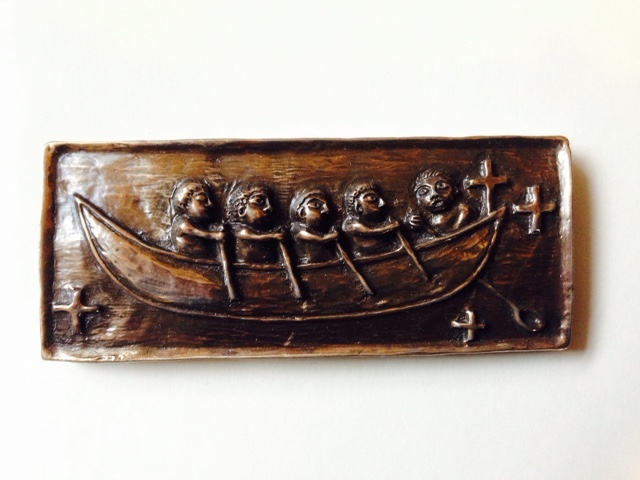
- Boats, on which to write the name of your church and the “word of mission” for you, are here.
- Lots and lots more information about the story and development of Opawa and espresso can be found here – start at the end and work forward!
Luke 14 talk – theme banquets as mission, their place and ours
- Quiz was taken from a book about meals from around the world
- The images of “church at table” were from Steve Collins website, particularly here.
- The Benched video, which was used as a way of reflecting on hospitality in shared community projects.
- The list of 4 hospitality practices which we used to evaluate the video (and thus our congregational life and hopes in general) was a summary of a chapter from Soul Banquets: How Meals Become Mission in the Local Congregation
. This also has the (fantastic) story of the response of a New York church to 9/11. The specific practices (as I reworded them) are as follows:
- Practice: serving graciously by finding ways to encourage eye contact and genuine conversation.
- Practice: setting tables in ways and places that reflect God’s abundance and creativity.
- Practice: seek role reversals by finding ways for all to contribute (a diversity of gifts, each has its corresponding service.)
- Practice: committing to a long-term, intentional project.
- For more about Richard Passmore go here, with the Abs and Flow story (which is one of the best example of Western contextualisation I have seen) here
- The cartoons were from Dave Walker, in particular here
Benched from Brandon McCormick on Vimeo.
Luke 19 talk – theme the gospel at their place
Wrap up summary
Information about Lumina Domestica, God’s light potentially transforming the ordinary and everyday of our hospitality, here.
Two books I’ve found most helpful have been Amos Yong’sHospitality and the Other: Pentecost, Christian Practices, and the Neighbor
Sunday, August 15, 2010
a sociological reflection on the growth of fresh expressions
Interesting article by David Allis, exploring growth (numeric) in new forms of church/fresh expressions. David is a Kiwi, who withdrew from the more Pentecostal end of church life to focus on a home church in his local neighbourhood. The article is a few years old (2007), but makes some good points. David suggests that when we look at new forms of church we need to realise that:
- Slow Growth is Normal. Allis quotes (the excellent) Rodney Stark (The Rise of Christianity: How the Obscure, Marginal, Jesus Movement Became the Dominant Religious Force ….
, 6) who estimates that Christianity grew at 3.4% per year for the first few centuries. “Hence, anything new that starts with small numbers and grows at only a few percent per year, will take a long time to become large.” (This was certainly our experience at Graceway, starting with a small core team.)
- The drain created by existing models. “The existing church models are the norm, and people (both churched & unchurched alike) think this is the only way to do church.” This means that alternative models require people to have thought through new forms, or with new converts. Further, “It is difficult for a new small tree to grow under the shade of a large tree, as the large tree drains the nourishment from the ground and; also shades the light.” Yeah, all you light shaders! 🙂
- Exhaustion. Potential leaders are most likely to come from people who leave the organised church structure. They are often more ready to want to ‘take a break’ from church activities, rather than throw themselves quickly into something new. (I can certainly relate to this one. I’ve struggled to stay afloat in the last 6 months, let alone have energy for something else.)
(The full article is here). I think the points are well made, and as always, value any comments.
Wednesday, August 04, 2010
global missiology and church change: updated with visuals
Updated: For those interested, here is my powerpoint (mission and innovation for web) and (here) are my notes. There was a LOT of energy around especially the mission stories in history. It is so easy for Westerners to slip into mission as definitions and yet the use of stories in history brought a lot of energy and challenge into the room and ensured that discussion of innovation and leadership had a global God of mission framework.
Question: Where was the best place to train as a missionary in the 5th century?
I’ve had a wonderful few days, weaving up some new material for a pastors training day tomorrow. The theme is mission and innovation and I’ve had some time to do two things.
First, to integrate some current reading around innovation, change and leadership (see here for more).
Second, to add a global mission framework. It is so easy for church ministers to focus on church and so I’ve enjoyed exploring some global mission. Specifically to add a quiz, using the first thousand years of church history, which is an Asian, African and Middle Eastern history. And to add some stories, of wandering Celts and the first missionary to Vietnam in the 16th century. It is important to see fresh expressions and church change as powered by missio Dei and I’m hoping that this global mission horizon does that. This is in 4 pieces, so for those interested (more…)
Monday, August 02, 2010
Joining in with God’s Spirit: a great missional resource
God’s mission is greater than any church, and it is in this wider movement of the Spirit that all the churches in the world participate. It is within the greater purposes of God that we find our unity. The missio Dei is not confined to any locality; it spills over, crosses boundaries and is carried across the world by the wind of the Spirit. It does not have a single origin or one direction but comes and goes as the Spirit wills. However, it is one movement because the Spirit witnesses to a unique person, Jesus Christ of Nazareth, crucified and raised, who reveals the Father in heaven, source of all things. We have yet to realize that the cosmic Christ is manifested in the unity of local churches in the mission of the Spirit. When we do, we will connect world church with local mission. We will be able to join with the Spirit who moves over the earth sustaining our world and our life – the Spirit of Jesus Christ, who is given to bring about good news in the whole creation.
Conclusion from Kirsteen Kim’s Joining in with the Spirit
Books like these are essential to the missional church conversation. They offer the Western missional church the gift of dislocation. When you read chapters that start with the insights from contemporary mission in Africa and Korea and India, you are offered a missiology that is so much richer than your own. You are reminded that the missional God is up to so much more than patching up a declining Western church. That mission is so much deeper, richer and wider than bringing back the young people!
So I used Kirsteen Kim’s quote as a devotional beginning at our Masters of Ministry class last Monday. Each of us were invited to sit with the quote and as we did, to identify the phrase that most spoke to us. After sharing, we then prayed for the person on our right. Then together we said the Lord’s Prayer. Just a few minutes, but a great way to place ourselves, each other and our ministries in the caring context of God’s globally local mission.


 )
)