Sunday, July 27, 2025
brief review of Material by Nick Kary
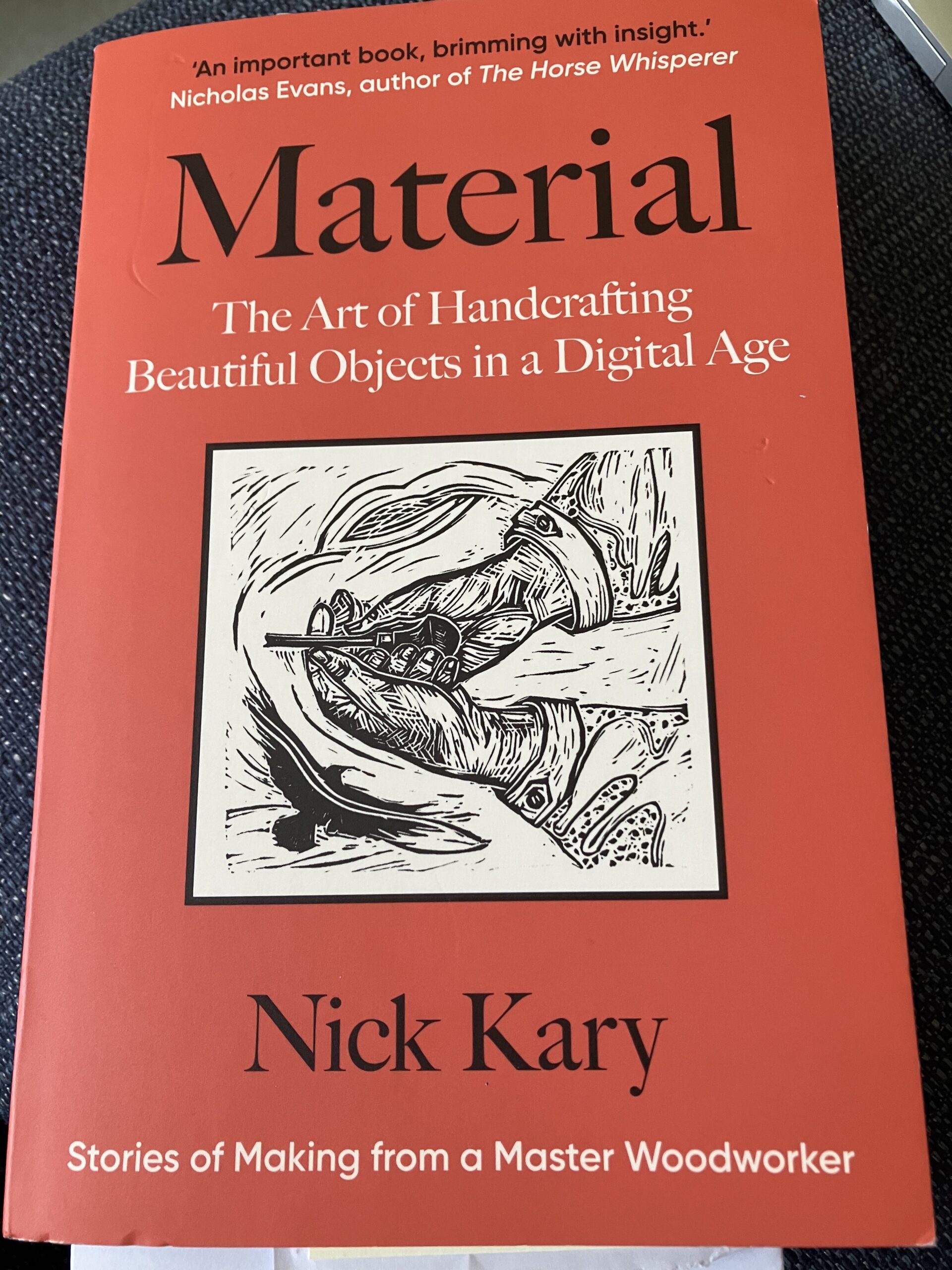 Glad to have read Material by Nick Kary. It explores handcraft by sharing interviews with crafters in the South of England. Basket makers, copper smiths, furniture makers reflect on place, making and identity.
Friday, September 20, 2024
Reading Allowed and aloud: Cultivating listening structures in a literary city
Paper acceptance!
 I’m thrilled to have a paper accepted for Books and the city: the 2024 Otago Centre for the Book Annual Symposium (21-22 November, 2024). The symposium is local, so that’s always a bonus.
My paper applies “listening structures,” a theoretical framework I’ve been reading around as part of my University of Birmingham, Psychology Cross-training Fellowship Programme for Theologians, to a local activity – Reading Allowed – that I’ve enjoyed being part of for the last few years.
Paper title: “Reading Allowed” and aloud: Cultivating listening structures in a literary city
This paper analyses the benefits of reading books aloud in public city spaces. Qualitative research is used to investigate the social impact of “Reading Allowed” as a collective listening structure.
“Reading Allowed” is an event that runs monthly on the ground floor of the Dunedin Public Library. Since 2022, people have gathered in the late afternoon to hear stories for all ages. For 60 minutes, readers from the University of Otago and Friends of the Library introduce and share excerpts from classic and contemporary literature.
Listening structures is a phrase used by organisational psychologist Guy Itzchakov (2024) to advance the science of listening. Listening structures refer to the processes and practices that build the human capacity to pay attention, deepen comprehension, and amplify intention (Kluger and Guy Itzchakov, 2022). Hence, listening structures contribute to social relationships and collective flourishing between individuals and organisations.
This paper considers “Reading Allowed” as a listening structure. It draws from the researcher’s ethnographic participation as a listener at “Reading Allowed,” along with interviewing readers and listeners. Attention, comprehension, and intention are themes used to analyse the qualitative data.
New ways to conceptualise the places of books in a “literary city” are provided when “Reading Allowed” is theorised as a listening structure. The research is theoretically important in advancing scholarship regarding the public nature of listening structures. The research also has practical application for those who care about books in the lives of cities and their citizens.
Dr Steve Taylor,
Director AngelWings Ltd; Research Affiliate, University of Otago | Ōtākou Whakaihu Waka
IASH Research Fellow, Edinburgh University
Thursday, March 09, 2023
pacific missiology in praxis: review of Winston Halapua, Living on the fringe.
 Winston Halapua, Living on the fringe. Melanesians of Fiji, Institute of Pacific Studies, University of the South Pacific, 2001, 152 pages.
Winston Halapua, Living on the fringe. Melanesians of Fiji is a fine example of Pacific missiology. Rev Winston Halapua, who at the time of writing was Archdeacon for Pacific Islanders in New Zealand and Principal of the College of the Diocese of Polynesia, seeks to “sing a divine song until the pain of the marginalized in our midst is heard” (6).
The book focuses on an economically deprived and socially marginalized people, Melanesians born in Fiji. Historically, Halapua traces the labour practices of the 19th century, which between 1864 and 1911, resulted in 27,027 contracts of indenture for Melanesian workers in Fiji. When cotton and sugar cane prices changed, many of these workers could not afford to return to their homelands. Caught by shifting patterns of land ownership, many found themselves trapped in generational cycles of poverty.
Theologically, Living on the fringe. Melanesians of Fiji follows God’s Spirit, which yearns to bless the poor, hungry and those who weep (Luke 6:20-21). Halapua demonstrates what blessing might look like and the importance of loving God and neighbour not just with our hearts but with our heads as well.
Prophetically, Halapua examines the historical actions of his own Anglican Church. The Anglican Church in Fiji, while initially established to provide pastoral care to settlers, in time began a ministry to the Melanesians in Fiji. Halapua explores a bold experiment, the Wailoku settlement, where the church sought to provide holistic care. Halapua analyses the church’s actions sociologically, demonstrating how the patterns of mission care matched the hierarchical structures of the Anglican church. This mission, although genuine in intent, served to amplify the embedded patterns of dependency.
Yet prophetically, Halapua is showcasing the contemporary actions of his own Anglican Church. Living on the fringe. Melanesians of Fiji emerges from current activity as teams of local Wailoku leaders, Anglican theological students, priests, and Diocesan staff undertake human research together to understand current realities. Hence Halapua shows that research need not be abstract. Rather, research can be prophetic praxis. The mixed methods approach is a fine example of research forward, in which documentary analysis, interviews with stakeholders and personal involvement result in concrete future strategies. A fine example is how Halapua applies a strength-based approach to the Melanesian people he is researching with. He names the gifts evident in history – “Melanesians played a vital pioneering role for the Anglican Church in Fiji” (127) to empower agency in future decisions.
Halapua writes for “the year 2040 AD,” the year in which the lease on the Wailoku settlement will end. He notes that even if 2040 seems far away, a distant date “should not lull people into a false sense of security.” Instead, this fine example of research forward provides “the information upon which Melanesians can make choices necessary for their self-determination” (128).
Thursday, January 13, 2022
Built for Change resourcing Transformative Possibilities for Christian Leadership in Higher Education
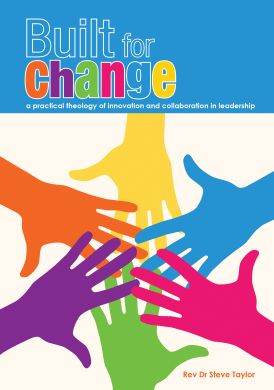
Lovely to see my 2016 book, Built for change: A practical theology of innovation and collaboration, referenced in a recent journal article in Black Theology out of South Africa.
Gordon E. Dames, “Transformative Possibilities of Pedagogics for Christian Leadership in Higher Education – a South African Practical Theology Perspective,” Black Theology here.
Built for change gets a nod in footnote 2 (of 176!) to support Gordon Dames’ claim that “The question of what we teach in the Christian academy presupposes collaboration and innovation.” The article goes on to argue for a new approach to leadership education, using an educational praxis to teach dispositions of ethical-justice and peace.
Gordon Dames is a Professor in Practical Theology at the University of South Africa and it’s just lovely to have my book being read in the context of educational transformation in the cultural complexity of South Africa.
Monday, February 22, 2021
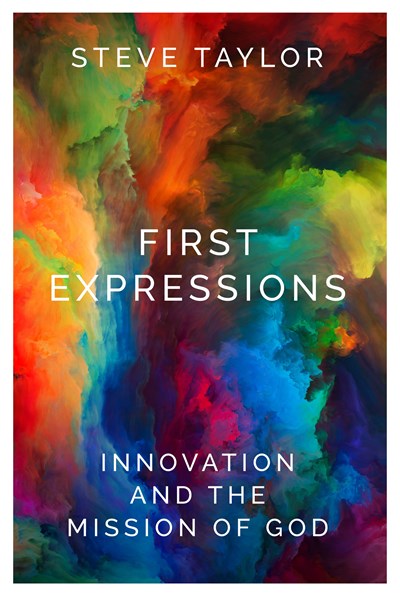
First Expressions “important insights”

To date, there have been four academic reviews (that I’m aware of) of my First Expressions: Innovation and the mission of God book. (To date on the blog, I’ve highlighted the 4 academic reviews — here in Ecclesial Futures; here in Practical Theology; here in Ecclesiology and a here in Scottish Episcopal Institute Journal).
Now I’ve become aware of a more industry-focused review from Church Missionary Society. As a missionary society, they produce a Summer reading catalogue and in 2020 readers are encouraged to read First Expressions: Innovation and the mission of God because it offers “important insights for the future of Pioneer and Fresh Expressions movements, gained from extensive research … excited, connected, curious.”

It’s so encouraging to have this type of feedback from an international missionary society, especially one that is focused on mission both local and global, and in such creative ways.
Friday, February 19, 2021
Mission For a Change introduced
Hosted by Rev Dr Steve Taylor (missiologist, researcher, educator)

Mission For a Change creates resources for those engaging in church mission, showcasing recent research and new ideas, as fresh thinking is applied in local contexts.
Mission For a Change is ideal for ministers wanting some short, sharp lifelong learning, students wanting to discuss fresh thinking and all who care about the future of the church’s mission. For 45 minutes, every month, there is time for prayer, interview, Q and A and conversation about the “so what.”
Participants have described Mission For a Change as
“real valuable. Good work”; “very insightful”; “informative and enlightening”; “a great Zoom session”
February’s Mission For a Change was a conversation with Rev Dr Hirini Kaa about his new book Te Hāhi Mihinare | The Māori Anglican Church. With Waitangi Day approaching, we discussed how the past can shape actions of the future church and the role of Christianity in Aotearoa’s future.
For a taster, see here
Upcoming Mission For a Change events
Wednesday 3 March, 4:45-5:30 pm (NZ time) – Gender, mission and reading Scripture for liberation
Is the history of Christianity full of “mansplaining”? Are there ways to read Scripture that give voice rather than create silence? What can we learn from Angelina Noble, Aboriginal mothers, Queen Sālote, Kate Sheppard, Hēni Te Kiri Karamu, Mary MacKillop and the Siwai mothers of Bouganville? As we approach International Women’s Day, how might Oceanic women help us tell stories of God’s mission?
Wednesday 7 April, 4:45-5:30 pm (NZ time) – God so loved the world and the environment in God’s mission
Wednesday 5 May, 4:45-5:30 pm (NZ time) – Imagining mission and the gift of creativity
Wednesday 4 June, 4:45-5:30 pm (NZ time) – Seeing mission, a quick tour of documentaries, films, images
For enquiries, contact Steve Taylor, Director AngelWings Ltd, by emailing: kiwidrsteve at gmail dot com.
To register to receive further information, monthly zoom links and reading resources go here.
Friday, December 11, 2020
celebrating First Expressions with my graduating department
 The Theology Department at Otago University have a lovely tradition, an annual end of year celebration of books written by Faculty and former post-graduates. Since I was a PhD post-graduate student of Theology at Otago back in the day, I was invited (back!) to celebrate First Expressions: Innovation and the Mission of God, the book I had published late in December, 2019. Here is my “celebration” speech, trying to link the book with the PhD research.
First Expressions: Innovation and the Mission of God is the 2nd book to emerge from my PhD research. I graduated with my PhD from Otago in 2004. As I finished my PhD, I wanted to make the research accessible to the wider church. So I wrote The Out of Bounds Church?: Learning to Create a Community of Faith in a Culture of Change
There was a large chunk of empirical research – ethnography, interviews, focus groups – I had to drop out of my PhD thesis. Because it was already too big. So I was keen to find a way to do something with that PhD research. So I sought ethics approval and did a longitudinal study. This involved returning 10 years later to the church’s I’d researched in my PhD.
I found that half of the new forms of church were no longer meeting as gathered communities. Which raised ecclesiology questions. Does it matter if innovation doesn’t endure? How might Easter – dying and rising –shape our ecclesiology?
During that 10 year period, the wider denominations – Church of England and Methodists in the UK – had affirmed these new forms of church. They had developed structures like Fresh Expressions to partner with them. So that raised another set of ecclesiology questions – How do organisations discern what is of God and what isn’t? How do churches as organisations best partner with grassroots innovation?
So I interviewed denominational leaders –Rowan Williams, former Archbishop of Canterbury and Stephen Cottrell who’s now the Archbishop of York.
Then I found a publisher – SCM. They have been great to work with.
According to Ecclesiology and international ecumenical journal – First Expressions is a “radical re-conceptualization of the marks of the Church” (more here).
According to the Scottish Episcopal Journal, First Expressions offers “in-depth theological hermeneutic, firmly grounded in Scripture and ecclesiology” (more here).
According to Rowan Williams, who emailed in January, saying he was – “impressed with the theological analysis .. [First Expressions is] an important book.”
Thanks to the University of Otago, who provided PhD scholarships and post-graduate conference funding. Thanks to the Theology Department for celebrating books emerging from PhD research. Thanks to any of you who might want to review it for Anglican Taonga or Methodist Touchstone!
Photo by Matthieu Joannon on Unsplash
Tuesday, December 08, 2020
help the entrepreneurs in ministry articulate vision and direction – First Expressions book review # 2
Another review of First Expressions: Innovation and the Mission of God
Rev Eleanor Charman is a priest at St Peter and the Holy Rood Episcopal Church and the first full-time curate ordained in Caithness since 1746 (According to here). So Eleanor is a bit of a pioneer herself!
After a fair review of the 4 parts of the book (and a much more positive engagement with my feminist methodologies and metaphors of innovation than the review of First Expressions in Ecclesiology), Charman concludes:
Taylor’s book reveals the myriad of complex dynamics that weave through communities as they seek to establish themselves … [Taylor] has systematically researched various aspects of the communities, through interviews and extensive reading. Taylor provides an in-depth theological hermeneutic, firmly grounded in Scripture and ecclesiology … the reader will have a better and more informed understanding of the nature of pioneering. This in turn may help the entrepreneurs in ministry articulate vision and direction with their gathered communities as they seek to establish new first expressions.
The Scottish Episcopal Institute Journal aims to be a vehicle for debate on current issues in the Anglican Communion and beyond. It invites dialogue on what it means to think as an Episcopalian in Scotland in the twenty-first century and aims to be a catalyst for prayer and theological reflection at the heart of the Scottish Episcopal Church. So it’s a really interesting context in which to have my work read in relation to helping “entrepreneurs in ministry articulate vision and direction.”
Thanks Eleanor Charman. Thanks SCM for publishing and for working hard at reviews.
Tuesday, November 24, 2020
radical re-conceptualization of the marks of the Church – First Expressions book review
There is a review of my book First Expressions: Innovation and the Mission of God
There are lots of affirmations by the reviewer. My book is”substantial” (429) and I’m at my best when engaging in “critical theological and practical reflection on his empirical research” (429). While First Expressions: Innovation and the Mission of God
There are some critical questions. My methodology is overtheorized (although better to be overtheorised than under, particularly when it comes to new areas of ecclesial research) and my fourfold typology for ‘innovation’ is confusing (need to be clearer that I am working with metaphors, which by nature require different ways of thinking).
So a mirror on my strengths as a thinker (theological and practical reflection on empirical research) and weaknesses as a writer (over-theorised). And some helpful pointers for further research and writing, for which I am grateful.
And an opinion – that I am offering something distinctly original – “an alternative paradigm for ecclesiology” (431). Across 20 centuries of Christian thought, what I am proposing is a “radical re-conceptualization of the ‘classical marks of the Church” (430), an ecclesiology distinct from paradigms of the church enshrined in historical continuity, hierarchical structure or ecumenical agreement. So that is very high praise – for my book and for Fresh Expressions/emerging church.
Monday, April 13, 2020
seeing faith: art and theology in Christ in the Wilderness
Christ in the Wilderness: Reflecting on the Paintings of Stanley Spencer
Art opens up the imagination. Cottrell reflects on the paintings of British painter, Stanley Spencer and in particular a Lenten series of paintings done by Spencer in the 1930’s. The book begins with a wonderful introduction to the spirituality and life of Spencer. Then there are 5 chapters engaging with 5 different paintings.
Cottrell is a brilliant communicator. The clever interweaving of stories from his life and experience, along with Biblical text, theology and the life of Stanley Spencer make for an accessible, yet at times profound engagement. Paying close attention to the imaginative work of an artist makes a space for stillness and reflection. At the same time, there is constant engagement with the life of Spencer, which adds layers of insight.
A picture a week made for a paced Lenten. Each picture is reproduced and in colour. The week began with a few days of my own contemplation on Spencer’s art. This was followed by reading slowly, a page or two, of Cottrell’s insights, as the week progressed. The result was fresh insights and a more contemplative Lent.

Tuesday, December 17, 2019
On Innovation and Mission: introducing my new book First Expressions
Steve Taylor introduces his new book First Expressions : Innovation and the Mission of God … 700 words to summarise a 95,000 word project …

On Innovation and Mission
Nearly half of fresh expressions will die. My research into new forms of church found 50% of churches had tried and died. My analysis of research by others found 62% of what were proclaimed as “models to hope on” had died.
A pragmatic ecclesiology values numbers. Like Dragons’ Den, a church with limited resources wants to invest wisely. If fresh expressions die, are they worth investing in? A pastoral ecclesiology values people. What is the impact on faith formation when the church that one starts and another joins organizes its own funeral? Is there an innovation ecclesiology, that can locate birth and death in the relationship between innovation and mission?
What research? To understand innovation in mission I studied eleven local church communities in England, Scotland and Wales. I came to call these communities “first expressions”. The name captures a “boldly go where no-one has gone before” approach to spirituality, evident as communities like Visions used video projection to transform church buildings in an Illuminating York Festival or Late Late Service explored “the music that we grew up with and forms of learning that we’re comfortable with” (God in the House, 1996). The term “first expressions” captures the new (and terrifying) reality of those who innovate without roadmaps from those who have gone before.
This was an empirical study. It is tempting for ecclesiology to work with ideals. I wanted to research reality. As Julian of Norwich declares, in one small thing – in my case “first expressions” – is all of creation. I developed a woven ecclesiology, that upholds the value not only of gathering in worship, but of intergenerational faith formation, leadership development and the making of creative product.
I returned 11 years later, to interview and to participate. This gave me a longitudinal study of first expressions, likely the first in the world. In focus group interviews, I heard stories of creative communities like Grace smashing their sense of identity in order to orientate around values not particular leaders. I interviewed leaders of the communities now dead and heard of “Vicar factories” in which the space to create and question resulted in leadership gifted to the wider church.
In the meantime, alongside these first expressions locally, church denominations innovated with Fresh Expressions. I expanded my longitudinal research to study Fresh Expressions as an organizational “first expression”, interviewing leaders like Rowan William, Steven Croft and Andrew Roberts, seeking to understand how a denomination might innovate in mission.
Why research? The research was shaped by my own story. I planted a first expression. Four years after I moved to another leadership role, I heard that first expression was preparing to die. This prompted my longitudinal research.
Through my research, I was challenged by a New Testament wisdom. None of the churches that the apostle Paul planted remain alive today. In Philippians, Paul writes to the very first expression of church in Europe. He names a pioneer that nearly died. Ephaphroditus is to be regarded as valuable. This is a Christian theology of risk, in which birth and death are affirmed.
I was blessed by the grassroots wisdom of local communities. Mobility, leadership transitions and the strength of wider relationships all impact on longevity. What was astonishing was the flexibility by which these first expressions explored new structures of leadership, clarified their identities in the midst of change and creatively drew on spiritual resources.
I was inspired by the organizational wisdom of denominations. In history, churches have innovated with structures. To help understand Fresh Expressions, I examined other mission structures developed in the United Kingdom, monastic patterns, early Methodism and the modern mission agency. I throw in wild cards of contemporary structures like NGOs and incubators. Innovation in mission often includes innovation in organizational shapes.
I was stretched by gender wisdom. The denominational leaders I interviewed were all men. This prompted an imaginative thought experiment. If Elizabeth was an archbishop and Mary was birthing an organization about to be named Fresh Expressions, what might be the shape of their strategic plan?
Innovation in mission is an activity of God. It embodies the word of Jesus: Unless a seed falls, there is no life. Julian was wise. In each small thing, there is value. The birth and death of first expressions invite a radical rethink of mission and ministry. A layered approach to ecclesiology, a church that is neither gathered and parish nor independent and networked, emerges. Innovation is the ants in the pants of Christianity. It keeps the body moving, not for the sake of growth but for the sake of birth and death, which are central to Christianity and thus to being church. Such is the gift of “first expressions”.
***
Order First Expressions via the SCM website before 31st December 2019, and you’ll benefit from a launch discount.
Steve Taylor is Principal of Knox Centre for Ministry and Leadership and author of First Expressions: Innovation and the mission of God, Built for change: A practical theology of innovation and collaboration
Thursday, October 10, 2019
“Jesus as innovator” conference paper acceptance
A few years ago, I began a research conversation with Dr Christine Woods, a Professor at the Business School at Auckland University. We had a mutual interest in social entrepreneurship and a shared question: does Christian faith offer anything to innovation? What in Christian resources might encourage the making of all things new?
One of the first tangible fruits of our shared conversation is the acceptance of a paper for United States Association for Small Business and Entrepreneurship 2020 conference. It’s a new space for me, but really interesting to see what might happen as Jesus is made present in this sort of context.
Title: Jesus as innovator: engaging in missional entrepreneurship
Keywords: Mission entrepreneurship, innovation, Christianity, opportunity
Abstract: Discussion on spirituality in entrepreneurship is an emergent area of research (Balog, Baker, & Walker, 2014). We explore one specific form of spiritual entrepreneurship: mission entrepreneurship, understood as realizing opportunities to bring about change inspired by Christ. We contend that a Christology of entrepreneurship can be found in the six images of innovation emerging from a biblical exegesis of 1 Corinthians 3, 4: serving, gardening, building, resourcing, risking and parenting. We discuss how these images form a framework that can be used as a pedagogical tool, and how the framework combines with the conventional idea to opportunity entrepreneurship process.
Acceptance involved not only an abstract, but also a 1,000 word summary in which we outlined our
- research question – what understanding can we then draw of an engagement with entrepreneurship from God’s word?
- methodology – “connectional methodology” from Paul Fiddes (Seeing the World and Knowing God
, 2013)
- contribution to entrepreneurship research – a Christology of entrepreneurship and innovation of six Christian acts of innovation – serving, gardening, building, researching, risking and parenting.
 , 2013)
The 2020 United States Association for Small Business and Entrepreneurship Conference is in New Orleans in January and Christine will be taking this one for the team!
Balog, A. M., Baker, L. T., & Walker, A. G. (2014). Religiosity and spirituality in entrepreneurship: a review and research agenda. Journal of Management, Spirituality & Religion, 11(2), 159–186.
Taylor, Steve, Built for change: A practical theology of innovation and collaboration
Friday, October 12, 2018
First expressions book contract
Another happy Steve moment.

I’ve recently signed a book contract with SCM Press, for a book on sustainability and innovation. The provisional title is First Expressions: emerging movements in mission. It will be drawing on my longitudinal research on new forms of church ten years on. I’m particularly interested in what we learn from those who try/play/experiment and how we theorise the tension between durability in cultures of continuity and fail fast in cultures of discontinuity.
I’ve had the empirical data for a while and the UK trip in June included the opportunity to connect with SCM editor, David Shervington who reached out on twitter and then graciously accommodated my lateness as the British Library refused me entry because my suitcase was too large. A book proposal and 2 draft chapters, some back and forth and SCM said yes a few weeks ago.
I never imagined writing one book, yet alone three, so I’m pretty pleased. I’m due for some sabbatical time February through May 2019, so the timing is perfect, with the full manuscript due to SCM in May. In the meantime, I have a few other deadlines to complete (ducking to hide from Jione Havea and Christine Woods).
Sunday, November 05, 2017
The Earth Cries Out book review


A Scripture, Romans 8:22 is used by way of introduction. Faith is a constant thread, closely examined through the lens of human pain. In the innocent eyes of a child the world is always big, held together by parental security and friendships of circumstances. Ruth’s gaze increases the sensitivity by which we contemplate the cries of creation. Theologically, there are no cliches. Only the reminder, that the cry for justice will never be stilled.
The story of West Papua is more complex than individual narratives of expatriate families such as Ruth’s. Etherington skillfully deals with this complexity through the use of individual vignettes – of plane crashes, Japanese invasion, botanical adventurers, mining – scattered through the narrative. Each stand alone, yet each in their uniqueness narrate the rich complexity of this island nation. In the interruptions, they are a poignant pointer toward beauty and history.
The Earth Cries Out


 )
)