Tuesday, December 07, 2021
workplace whole of life resourcing with Advent Tiredly
“Come to me, all you who are weary and burdened, and I will give you rest.” Matthew 11:28
I recently initiated a new online offering. Called Advent Tiredly, I wanted to offer online spiritual resourcing during December for those feeling ragged as a tough year ends. It was an innovation as part of my role as Director of AngelWings Ltd.

In 30 minutes, Advent Tiredly offers space to breathe in, to pause (with Anna, Mary, Elizabeth and Wisdom) and to breathe out with a story of contemporary Advent innovation. I offered it on Zoom, with the invitation to bring a “light” of choice – it could be the light switch in your room, a desk lamp or a specially chosen candle.
Watching participants in the moments of silence, I realised that a number were connecting in from their workplaces. Their zoom backgrounds were not lounge room sofas or kitchen tables. Instead what was behind them were office noticeboards and workplace glass partitions. This meant Advent Tiredly was enabling me to read Scripture, the stories of Anna, Mary, Elizabeth and Women Wisdom, in peoples’ workplaces.
After the first week, one participant, Lynne Taylor, posted this photo on her facebook.

Notice the open work diary on the right, the computer keyboard front and centre, the monitor to the back. Advent Tiredly spiritual resourcing occurs within her everyday working world.
She wrote the following words on her facebook:
“Blessed by a moment to breathe. Advent tiredly … Leaving a reminder for tomorrow.”
As she enters her work the next day, spiritual resourcing will be remembered. Faith will greet her as she opens her office door.
This online resourcing stands in stark contrast to so much religious resourcing. As a church minister, I would normally read the story of Anna in a church building not in a persons’ workplace. If I was pastorally visiting during the week, I would most likely catch up with a Monday to Friday worker in a cafe. I’ve never read Scripture in their working office. Yet here, through online resourcing, I was holding sacred space for people amid their computers and filing cabinets and work place diary appointments. It was a wonderful reminder of the everyday and whole of life potential of online resourcing.
Advent Tiredly runs for the 4 weeks of December. Wednesday’s 1, 8, 15, 22 Dec, 30 mins from 4:45 -5:15 pm (New Zealand time). A $5 cost per session is suggested. To register click here.
Wednesday, March 25, 2020
Annunciation in a time of Isolation
I write from home on lockdown eve. A national state of emergency has been enacted, and at midnight on the 25 March 2020, all of Aotearoa New Zealand has been ordered to isolate for the next four weeks. All over my nation, people are returning home. Parents are becoming teachers. Kitchen tables are now work desks, while fridge doors have new daily routines and economic fear gnaws.
Aotearoa New Zealand is not alone. As I write, more than 1.7 billion people worldwide, over a fifth of the world’s population, are secluding themselves at home.
In the calendar of the church, the 25 March is a Principal Feast. Hence on this 2020 lockdown eve, the lectionary texts revolve around the annunciation of Our Lord to the Blessed Virgin Mary.
In Luke 1:26–38, the angel appears to Mary, announcing good news. God is conceiving life, in the form of Jesus of Nazareth. In the tradition of the church, this announcement of God’s activity is in the context of seclusion.
This is beautifully portrayed in The Annunciation, an artwork by Filippo Lippi (1450s), that hangs in Room 58 of the National Gallery in London. Mary is (humanly) alone. She is seated inside a house, isolated from the outdoors by a stone wall. Behind her is stone stairs, suggesting further layers of enclosure. In front of her is the garden, although even that is enclosed. This is a woman alone and physically separated. Whether this was reality, we do not know. How much of this is patriarchy, with Mary entombed by external prejudices and cultural bias, whether from century villagers or fourteenth century is also unclear.
What is clear is that in this isolation, Mary is surrounded by Divine activity. She stares at an angel, who has slipped over the enclosed garden wall to kneel in respect. Above Mary is the hand of God, a motif present in so much baptismal art. Filippo Lippi presents the hand as breaking through the roof, a foreshadowing of the paralytic who will descend through the roof to be forgiven and healed by Jesus in Mark 2:1–12.
A bird hovers in front of Mary’s womb. The detail is extraordinary. A spray of golden particles issues from the beak of the dove. It is common in Annunciation art for the dove to be located above Mary’s head. Filippo Lippi provides a new intimacy, as the Spirit draws near to the womb the angel is blessing. Annunciation thus offers a theology of isolation.
First, what is clear is that a home is a place of encounter. Much of religious activity is centred on the church. We expect the Spirit to be present Sunday by Sunday as the faithful gather around the body of Christ. In the annunciation, God is present in the home. This is good news for the millions of humans currently in lockdown. As we gaze longingly at our gardens, God’s hand can enter our rooms. As an external virus entombs us, God’s Spirit draws near.
Blessed are the secluded
For they will experience God
Second, the house protects. The womb of Mary will house the son of God. God’s Spirit’s draws near, proclaiming favour on the womb of Mary. This womb will house the son of God. In the flow of blood and the bodily tasks of eating and drinking, Divine life is safeguarded. This is what makes Christianity radical, for in God, bodies matter. This is the genius of Filippo Lippi. Mary’s womb, that human body that will house the divine body, is inside a house. Do the stone walls enclose? Or do they protect?
Blessed is the home
For protecting of divine encounter
Third, in seclusion is new life. The word “conceive” is used twice (verses 31 and 36), as is the word “birth” (verses 31 and 35). So much of Christianity seems focused on death, yet the story of Jesus brims with new life. The Spirit that hovers over Mary is the Spirit that hovers over the waters in Genesis 1:2. It is the Spirit that makes birth again possible for Nicodemus in John 3:4–6. It is the Spirit that groans with creation in the pains of childbirth in Romans 8:22–23. In 2020, this same conceiving Spirit continues to hover over our locked-down bodies. Bonhoeffer wrote that in birth, God in Jesus Christ claims space in the world as a “narrow space” in which the whole reality of the world is revealed (Ethics (Dietrich Bonhoeffer-Reader’s Edition)
This narrow space that is the hope of a new creation is conceived in the four walls that enclose Mary. In 2020, the narrow spaces that are the four walls of our home might yet be the womb of God’s new creation. Might we emerge into a new world in which a universal basic income protects the vulnerable? Might we cultivate different habits, like sabbath and localism, which change the nature of global pollution?
Blessed is time
For in the moment is grace
Fourth, an agency is established. In Luke 1:26-38, despite being secluded, Mary is no passive passenger. She is an agent, choosing to open herself to God’s mission of favour. As she utters the words “Here I am” (verse 38), she is locating herself in the genealogy of God’s servants. She is taking her place alongside Moses in Exodus 3:4 and the prophet in Isaiah 6:8.
How might Mary’s agency be portrayed in art? What Filippo Lippi does is extraordinary. A close examination of The Annunciation shows a spray of golden particles pours from the beak of the hovering dove. An answering spray of gold golden particles issues from a tiny parting in the tunic of Mary. This is Mary “active and outgoing” according to John Drury, former Dean of Christ Church, Oxford (Painting the Word: Christian Pictures and Their Meanings
Blessed are the isolated
For they participate in God’s conceiving
In time, Mary will be no stranger to sorrow. The years that lie ahead of her will be stained by tears and pain. God’s favour is no offer of a rosy garden. Yet on the Feast of Annunciation, we in 2020 find a theology of isolation. Enclosed in our homes, God’s Spirit is active. Entombed by the invisible, we have agency. In the narrow space in which we, as a global society, find ourselves, a new world might yet be conceived.
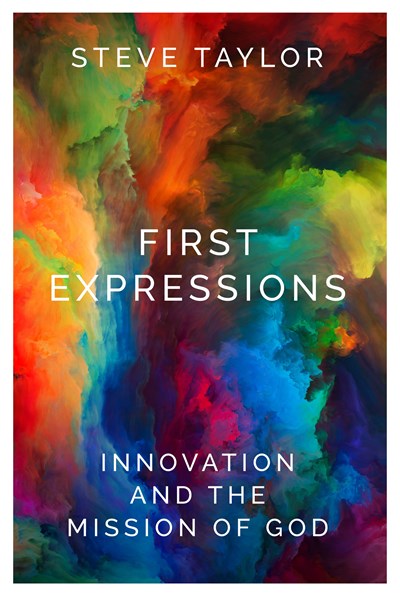
Rev Dr Steve Taylor is Principal of Knox Centre for Ministry and Leadership and explores ecclesiologies of birth and conception in First Expressions: Innovation and the Mission of God
Friday, March 06, 2020
making matters grassroots impact #Kiwiangels
 I really enjoyed presenting at St Lukes Presbyterian yesterday. It was great to have the opportunity to offer to a local church and nearby ministers some of my study leave from last year. I took my presentation from Durham Ecclesiology and Ethnography Conference in September. I added in a 15 minute introduction to the variety of ways the church might be “making” – for good and bad – in the world today. I also generated some “free range” activities, to mess with the usual question and answer time by adding things to see, do and make. It was gratifying to overheard conversations as the evening ended plotting Christmas 2020 projects and I came away with the sense of being directly useful to the local church.
Making matters: yarn-bombing and craftivism in contemporary Christian mission
There was some very rich discussion, particularly around the materiality of knitting. The discussion was rich enough to generate 900 words as I wrote this morning, reflecting on the Incarnation in light of the useless yet playful act of yarnbombing knitted angels.
One of the unexpected blessings was becoming aware of the impact of my writing in the lives of ordinary people in the Presbyterian church. In October 2019, I wrote a column for SPANZ, the publication of the Presbyterian Church. Under the title “Making matters,” I concluded,
Are there makers in Presbyterian churches? Yvonne Wilkie, our Church’s former archivist, recalls knitted nativities in Presbyterian history. But that was the past, and we all now live in the present.
The instructions are online (https://www.christmasangel.net/). They are simple enough that, as part of my research, I learnt to make one. Is anyone interested in making and mission, with a downunder #Kiwiangels hashtag? Or are Kiwi summers now too busy and too hot for making to matter?
Last night at St Lukes, I met a person who told me she had read the article and promptly knitted 30 angels, which she gave over Christmas 2019 to her friends and neighbours. Each was thoughtfully and carefully personalised, an act of love. It was humbling to be made aware my written words and study leave research had contributed to a kinder world. Study leave research generates grassroots impact 🙂 Yee ha.
Friday, February 28, 2020
Making matters
Making matters: yarn-bombing and craftivism in contemporary Christian mission
What is the role of making in contemporary culture? From pink pussy hats to yarnbombing – craftivism combines craft and activism, providing hands-on ways to engage in change. In 2014, Christmas Angels began as a project of Methodist churches in the North of England, yarn-bombing their communities with hand-made angels. By 2018, the number of Christmas Angels knitted in Great Britain were too many to count. Steve Taylor shares his research, focused on those who received these angels. How was good news as craft experienced? How might making provide new insights into Christian faith and mission as hands-on?
St Lukes Remuera, 130 Remuera Road, 7:30-9 pm, Thursday 5th March.
Steve Taylor is Principal of Knox Centre for Ministry and Leadership and author of 3 books and over 200 articles and publications. His latest study leave involved learning to knit and using digital ethnographies to study making in mission. Steve Taylor is married to Lynne, and together they enjoy two adult children.
Tuesday, September 17, 2019
first day back from sabbatical
Yesterday was my first day back from sabbatical. The day began in Glasgow and ended in Durham and involved four meetings, two in Edinburgh, followed by two in Durham.
First in Edinburgh, a conversation with Dr Carol Marples, who recently gained her PhD for research into creativity in worship, emerging from Carol’s training as an artist and work with congregations. We talked together about ways that she is seeking to cultivate collaboration in creative making in congregations, including developing short courses.
Next in Edinburgh, a conversation with Dr Alexander Chow, Lecturer in Theology and World Christianity at Edinburgh University. I was particularly interested in his use of wikipedia, requiring students to complete assessment that includes writing articles for wikipedia. It strikes me as a great example of making research useful.

Then onto/back to Durham. The presentations I am offering here in the UK during this trip involves research on the church in the United Kingdom, in particular the impact of Christmas knitted angels. So I contacted folk who began the project and asked if they were interested in hearing about my research.
So a meeting with Dr Christine Dutton, who as Methodist minister encouraged her congregations’ involvement. I have also drawn on her research into knitting as missional practice and together we talked about ways we might conduct further research together, given her strengths and expertise.
Finally, a meeting with David Wynd and Rob Wylie, who had seen some creativity from the gifted Lou Davis, a Methodist pioneer minister and encouraged the Christmas knitted angels project. I interviewed them about their hopes and dreams for the project. Then I gave them a summary of what I had discovered from my research into how folk had experienced receiving an angel. Then we talked about the possibility of a Christmas angels downunder experiment, testing to see how knitted angels upside down – in summer – might work.
So ended the first day back from sabbatical. Rich, full of meetings and hopeful of next step possibilities in research and mission in the church. Today, Tuesday, is my second day back from sabbatical. It involves a morning meeting about another possible collaborative research project and then the Ecclesiology and Ethnography 2019 conference which begins with lunch. Equally full, although thankfully with less travel.
Tuesday, July 16, 2019
Faith of girls and the mission of men
I write a column for Zadok, an Australian print publication, every quarter. It is a print based publication which they let me share on my blog, to resource more widely and generally. Here is my column for Autumn 2019, on gender and mission.

Faith of girls and the mission of men
When I hear talk of gender and faith, I think of Tarore, an indigenous Maori girl, born around 1826 in Aotearoa New Zealand.
Her father Ngakuku, came into contact with pioneer missionary couple, Rev Alfred and Charlotte Brown. Ngakuku’s daughter, Tarore, aged ten, showed an interest in learning to read and write, using a Maori language translation of Luke’s Gospel. She was a gifted student and quickly became an oral storyteller. Crowds, sometimes 200-300 people, would gather to hear Tarore share in Maori the Good Samaritan and Prodigal Son. Ten years old and a woman, she became known recognised in her Maori community as an evangelist.
This moment in the life of Tarore reminds me of Lo-ruhamah in Hosea 1 and Namaan’s wife’s slave girl in 2 Kings 5. All three are pre-pubescent girls and all three are agents of a new theology. God is made more real, more understandable, more present, through the faith of girls (For more, see The Faith of Girls
Tarore’s story is consistent with the history of mission. Time and again, the Gospel has spread not through missionary preaching but through indigenous proclamation. It begins with the Spirit at Pentecost as those from diverse cultures hear “in our own tongues” (Acts 2:11). The missionary is essential, Peter will preach but the Gospel spreads as people giving voice in their own language.
As 1836 ended, Tarore’s world grew increasingly tense, with increased conflict between local Maori tribes. On 18 October, Tarore was killed by a raiding party. At her funeral, her father, Ngakuku, proclaimed the need for forgiveness: “Do not you rise to seek a payment for her, God will do that. Let this be the finishing of the war. Now let peace be made.”
Meanwhile, Paora Te Uita, the man who killed Tarore, took her belongings, which included her beloved Gospel of Luke in Maori. Paora Te Uita couldn’t read. But he had a slave, Ripahau. Like Tarore, Ripahau had learnt to read through contact with missionaries. Ripahau read Luke (in Maori) to Paora Te Uita, who was deeply moved. He sought out Tarore’s family to seek forgiveness. Once again, we have a hearing in their own language and once again, we have an indigenous person, radically embodying the radical Gospel.
Meanwhile, Ripahau, upon release, returned to his home with Tarore’s copy of Luke. Those who listened included Katu Te Raauparaha, a local chief, who set out to make peace and halt a spiralling cycle of violence. Again, in the lives of Ripahua and Katu, we glimpse how faith is transmitted, carried by indigenous people who hear in their own language. (For more, see For more, see Nga Kai-Rui i Te Rongopai: Seven Early Maori Christians, Te Hui Amorangi ki te Manawa o Te Wheke, 2013).
I thought of Tarore when the news of the death of John Chau broke. John Chau was a twenty-six year old American, who made an illegal—and tragically fatal—voyage to visit a remote tribe in the Indian Ocean. The media sifted through John’s social media profile and suggested a range of motives: an adventuring spirit, Western optimism and a passion to reach the unreached.
Clearly there are differences between Tarore and John. One was indigenous and female, the other Western and male. One was a reciever of initial mission, the other wanted to be an initator of initial mission.
Yet there were also similarities. Both died early, with many years of life ahead. Both died at the hands of another. Both died in the context of missionary zeal and cross-cultural tension.
In the history of Christian mission, those who initiate mission have rarely been effective as proclaimers. Missiologist Lamin Sanneh examined the contradiction: Christianity has spread, yet rarely by missionary preaching. Sanneh, an adult convert from Gambia, became a Professor of Mission at Yale Divinity School. Sanneh argues that mission spreads as missionaries focus on translation. In Jesus, the Word becomes flesh and through the Spirit, the Word is heard in their own language. Sanneh calls this the “translatability” of the gospel (Translating the Message: The Missionary Impact on Culture
This has four benefits. First, it turns the missionary from initiator into a receiver of indigenous knowledge. Second, it makes local culture a carrier of grace, as God moves into the neighbourhood ( John 1:14), accessible through local language. Third, Bible translations tend to use popular language, a liberating move in hierarchical cultures. It results in a pre-teenage girl like Tarore being recognised as an evangelist. Fourth, no one culture is ever above critique. In Africa, among the Zulu people, translation resulted in the missionaries being told to read the Bible. Surely Genesis 27:16 affirm not the colonial safari suit, but indigenous practices of dressing in skins. Fifth, as people hear in their own language, they become agents of change. The cyles of violence in New Zealand cease as indigenous people embody the Good Samaritan and Luke’s radical call to forgiveness.
Tarore and Chau are very different, yet side by side, they teach us much about faith. There is great potential when missionaries are not initiators but learners and indigenous people are the primary Gospel heralds. That even in the unbearable pain of losing a child, peace can be made.
Thursday, April 18, 2019
craftivist research: coding round 1
So I am coding. As introduced earlier this week, I have 1100 individual tweets; 22 pages of data. These have been printed on A3 sheets, leaving me with margins to scrawl notes as I go.
 Over 3 afternoons this week, when I need a break from writing on the First Expressions book project, I have laid out the highlighters – orange, yellow, green, pink. I have added the pens – red and black – and a pencil. Potentially 7 different categories.
I have then simply read each tweet, word by word, looking for themes. When I think there is a theme I write it down on a blank A3 sheet of paper. Then whenever I see that theme in the data, I use that colour highlighter. For example, pink is warm comments – words like lovely. I mindmap related words. Cute is similar to lovely, as is beautiful, so I add that to the related words and in pink I underline lovely/cute/beautiful whenever they appear.
This is a first read. I’m trying to get a feel for the data, to notice trends and seek patterns. There will be themes that will need to be merged, or themes that will probably appear on a subsequent read. I realise that my data set is corrupted. the hashtag Xmasangel has pulled in other data. This is fine, I can cull the database before I read again.
As I go, I make notes of impressions. This will need to be verified, by numbers, by assembling quotes. But I am getting a feel for the data.
There will be a second read and perhaps a third round. I have the data as a master, so will photocopy off another A3 sheet and using the codes I already have, I will start again from the top and read through.
This is intuitive. I am wanting to be able to stand in front of a group of peers and be able to say – these are the main themes in this data – and here is the evidence to explain and support these main themes.
My initial impressions – in no particular order – are as follows,
- the overwhelming sense of joy and positivity generated by Christmas Angels. In the 1,100 tweets, there is only one that might be read as negative. The word “lovely” and “thanks” were dominant
- the place-based nature of this community engagement. Invariably tweets named locations. These could be towns, streets, park benches, homes, train stations etc. There is a strong sense of connection with place being evoked by the angels. The angelic goodwill is not being heard in Bethlehem but in local communities and closes, streets and high streets shops, in contemporary England.
- the layers of participation, both for senders and receivers. Senders source materials, make, tag, box, commission, deliver and tweet. Receivers find, carry, display, home and tweet. Indeed it could be argued that there is a making of angels as senders and a making of homes as receivers. Making is an essential part of this mission and in making, connections are deepened and meaning is being made.
- the way the project built connections, particularly within households and between church and community.
These four themes are articulated in one tweet: “What a lovely idea. Daughter found this for me now taking pride of place on tree.” There is the positivity of response (“lovely”), the place-based nature (on tree), the layers of making (participation by the receiver of finding, homing, tweeting) and the building of connections (between daughter and parent).
I’m in a really happy place doing this. I love being curious about the world, in particular about mission and how fresh expressions of mission are received. I’m also curious about the domestic and gendered, the place of making in knowing, what is and is not communicated in craft and tactility.
And a reminder: of the craftivism Christmas angels research project (full outline here).
Background: I am interested in fresh expressions of Christian witness. One recent fresh expression I’ve become aware of is Christmas angels. It is a form of How to Be a Craftivist: The Art of Gentle Protest
To address this question presented some research challenges. I live in another country, it is not currently Christmas and I don’t want to look like a stalker, chasing people who find Christmas angels to ask for an interview. Helen Kara’s Creative Research Methods in the Social Sciences: A Practical Guide
Research method: To address this question, I am experimenting with analysing social media. Each angel was sent out with a hashtag #Xmasangels. This meant that people who received the angels could interact and in ways that are in the public domain. This provides a way to analyse recipent response – How people responded to the angels? What meanings did they make? With help from a colleague, I have extracted over 1,1000 #Xmasangel hashtag tweets. I am now conducting thematic analysis. This will be brought into dialogue with the literature, particularly a theology of making and the place of domesticity and craft in contemporary cultures.
Outcomes? Action-reflection on mission action, research-informed teaching (at KCML and as I am invited by churches to talk about fresh expressions of mission), presentation of data at academic conferences, writing for industry (Candour, Spanz) and an academic journal, possible engagement with Christmas angel organisors.
Monday, April 15, 2019
craftivism research: recipient responses
I’m around the halfway mark of the sabbatical. After 6 weeks, I’ve completed some major tasks
- 10,000 word journal article on mission submitted
- 6,000 word journal article on life-long learning submitted
- article to SPANZ completed
- article to Candour after Christchurch mosque murders on Spirit in trauma completed
- Sydney Learning and Teaching conference presentation completed (feedback here)
Plus I have completed around 22,000 new words on the First Expressions book project. I’m around 7,000 words ahead of schedule and I’m moving into the editing stage. So I need to adjust the shape of my sabbatical.
It’s time for a more playful task alongside the editing tasks and as a way of celebrating after the completing tasks. I will continue to write on the First Expressions book project in the morning but I’m picking up a more creative project in the afternoons.
Background: I am interested in fresh expressions of Christian witness. One recent fresh expression I’ve become aware of is Christmas angels. It is a form of How to Be a Craftivist: The Art of Gentle Protest
To address this question presented some research challenges. I live in another country, it is not currently Christmas and I don’t want to look like a stalker, chasing people who find Christmas angels to ask for an interview. Helen Kara’s Creative Research Methods in the Social Sciences: A Practical Guide
Research method: To address this question, I am experimenting with analysing social media. Each angel was sent out with a hashtag #Xmasangels. This meant that people who received the angels could interact and in ways that are in the public domain. This provides a way to analyse recipent response – How people responded to the angels? What meanings did they make? With help from a colleague, I have extracted over 1,1000 #Xmasangel hashtag tweets. I am now conducting thematic analysis. This is fancy words for printing them out – all 22 pages – on A3 sheets of paper, finding highlighters and coloured pens and reading every tweet, looking for themes.

Research methodology: As another part of the research, I am also learning to knit. I figure that it is one thing to engage #Xmasangels intellectually. It is quite another to engage by actually making Christmas angels. So I have started to learn to knit. I am keeping a diary of my experiences. It is fascinating to be learning to craft as I am researching craft – a tactile embodying of research. (For those who keep watch on how KCML staff spend their time, rest assured I am knitting after hours and not in work hours).

What will be the outcomes? I think knowing how people respond to mission is important in guiding future mission action. It is the basis of practical theology and action-reflection modes of learning. I hope to include the results as I teach on mission at KCML and as I continue to be invited by churches to talk about fresh expressions of mission. I hope to present the data to at least one, ideally two academic conferences, as part of reflecting on mission. I hope to write up the results, so that those who don’t hear me talk can still engage with the data. This will include Candour, Spanz and an academic journal. I will also send the results to the Christmas angel organisors. They might want to engage with me and I’m happy to do that. I hope to learn to knit. Above all, I hope to continue to be curious about the world around me and especially fresh expressions of Christian witness.
Over the next few days, I will share my initial impressions of the first read (fancy word for colour coding with highlighters) of the data. While is it very early days, I am already struck by some fascinating recipient responses.
Tuesday, December 11, 2018
Stretch marks on an ecclesial body: Gender and emerging expressions of faith in women and girls abstract
On the last night before going on holiday, with a mountain of work to do, why not write an abstract for a potential conference – The Faith lives of Women and Girls, Birmingham, 26-7 March, 2019. But it is, after all, Advent – a time of stretch marks when faith is being carried by the faith lives of Mary and Elizabeth.
 Photo by Alicia Petresc on Unsplash
Stretch marks on an ecclesial body: Gender and emerging expressions of faith in women and girls
While birth is a significant issue for all humans, the impact of gender on faith development is under-researched. This paper examines the interplay between birth and faith development, paying attention through longitudinal research to stretch marks on the ecclesial body of an emerging church community in Aotearoa New Zealand.
Empirical data – gathered from surveys, focus groups and participant observation – showed increased rates of belonging and a sense of growth among women over time. In contrast rates of belonging and a sense of growth declined among men over time. What factors were shaping the faith lives of woman and girls in this ecclesial community?
Attention is paid in the first instance to artistic production, initially in a contemporary Stations of the Cross art exhibition, but increasingly over time through Advent in Art creative practices. Analysis of visual and verbal texts suggests a shift in faith, from deconstructed in death, to stretched through natality. For Grace Jantzen (Redeeming the Present
At Easter, death and life are located in a linear and discontinuous relationship, while in Advent, life emerges amid the fear of death. At Easter, faith was resourced synchronously, with an art exhibition which gathered people at set times. At Advent, faith was resourced asynchronously, through postcards designed to be used as a daily resource in the midst of life.
The argument is that gender has an essential role in faith formation, particularly in relation to giving birth and human experience as a constructive resource. Natality becomes an important factor in theorising faith development, something that women can inhabit, yet men can only watch.
Monday, December 19, 2016
Christmas greetings from KCML
 I write to offer you Christmas greetings from KCML. Thanks for your support, encouragement, advocacy and input over the 2016 year.
For KCML it has been year of growth. Some highlights include
• The shift of Malcolm Gordon to Dunedin and the blessing of KCML corridors filled with creativity and music
• Six graduating interns from 4 different cultures
• A block course in Wellington for the first time ever
• Four new babies born to the ministry intern cohort
• The first ever Local Ordained Ministry resourcing conference
• A hard-working Faculty who have published 3 books and 2 resources, all engaged with aspects of the church in mission and ministry
• The Christianity and Cultures in Asia lecture series
• A significant increase in funding from Presbyterian Development Society in support of New Mission Seedlings
• The approval of the Thornton Blair Christian Education Research Fellow to guide the development of life-learning
• Two online learning experiments to explore being national in our training
• Partnerships in Alpine and Otago and Southland Presbyteries in establishing New Mission Seedlings.
It has also been a year of challenges. These include
• A new team still learning how to pace ourselves
• A number of our graduating interns as yet unplaced
• The ongoing challenge of living out the bicultural and intercultural commitments of the PCANZ
A recent lectionary Psalm speaks to our highlights and our challenges. In Psalm 67, the Psalmist is full of praise, for God’s face shines. It is an echo of the blessing of Numbers 6:24-26, a God of blessing, protection and grace. For the Psalmist, this blessing applies not to Israel but to all the nations. The potential internal and exclusive focus of Israel is re-shaped by this universal love of God. It is this God that we affirm at KCML and as a church look to celebrate this Christmas.
Thanks for your partnership with us. We’re better together.
May you and yours experience the shining face of grace this Christmas,
Steve Taylor
Wednesday, December 07, 2016
Arrival: an (Advent) film review
 Monthly I write a film review for Touchstone (the New Zealand Methodist magazine). Stretching back to 2005, some 120 plus films later, here is the review for December 2016.
Arrival
A film review by Rev Dr Steve Taylor
“If you could see your whole life laid out in front of you, would you change things?”
Dr Louise Banks
Western culture tends to think in straight lines. We imagine a linear future getting brighter. Arrival invites us to think in circles and examine the consequences.
We begin with Dr Louise Banks (Amy Adams), grieving the death of her teenage daughter, Hannah. We end before the beginning, in the tender love within which Hannah is formed. The plot’s circular nature makes sense given the internal linguistic developments.
Banks is a gifted linguist. She is asked by the US military to establish communication with twelve alien spaceships that have suddenly arrived and positioned themselves around the globe. Taking a risk and drawing from the mathematical insights of fellow scientist, Ian Donnelly (Jeremy Renner), Banks begins to realize the aliens communicate in a circular form. It is a way of thinking that can only be grasped when the end of the sentence is understood before the beginning. The discovery enables Banks to not only avert a global conflict, but also make sense of her personal life. Hence the circular and philosophical logic of her question: “If you could see your whole life laid out in front of you, would you change things?”
The result is a plot that sustains both emotion connection and intellectual curiosity. A strong emotional narrative is generated, first in the joy shared between Banks and her growing daughter, second in the grief as Hannah succumbs to cancer. The alien presence and the resulting linguistic puzzle, offers a pleasing set of interlocking intellectual plot-circles.
Arrival is directed by Canadian, Denis Villeneuve, three-times a winner of the Genie Award for Best Direction. The film is an adaptation of Tony Chang’s Story of Your Life. Chang, American born of Chinese descent, has written fifteen short stories, gaining a string of literary awards (including four each of the prestigious Nebula, Hugo and Locus Awards).
As we approach Christmas, it is interesting to lay Arrival alongside the Christian understandings of a baby in whom is God. In other words, the arrival of mystery comes not in alien technology spread around the globe but in the vulnerability of a baby born in a particular Jewish stable.
Unraveling this mysterious communication from another place is not the domain of gifted linguists. Rather, it is for those who let the children come. The Christian God of Christmas speaks not in complex linguistic forms, but in baby babble. It brings to mind the words of the twentieth century’s most famous theologian Karl Barth. When asked to sum his whole life’s theology in one sentence, his reply was more circular than linear. “Jesus loves me, this I know.” It is a response in which complexity and mystery are enfolded in love. Such is the understanding of revelation present in the Christmas “arrival.”
Rev Dr Steve Taylor is Principal of Knox Centre for Ministry and Leadership, Dunedin. He is the author of Built for change (Mediacom: 2016) and The Out of Bounds Church? (Zondervan: 2005) and writes widely in areas of theology and popular culture, including regularly at www.emergentkiwi.org.nz.
Monday, March 03, 2014
Ecclesial practices proposals for American Academy of Religion
I was very excited to hear last week that American Academy of Religion, one of the largest academic conferences in the world, had added a new subject area – Ecclesial Practices.
While this is exactly in my area of current research, the deadline for papers was today, Monday 3 March. So I’ve been working most evenings, trying to knock something together. Each person is allowed to submit two papers for consideration. This involves a 150 word abstract, plus a 1000 word proposal, which if accepted need to be further developed for presentation (at the annual conference in San Diego in November). It’s a fair bit of work!
But I’ve been searching through my hard drive, and been pleasantly surprised to discover some bits and pieces of writing from a number of sources that can be massaged into something I think is cohesive.
For those interested:
Proposal for Ecclesial Practices and Practical Theology: Lost in translation: the priority of anecdotes in discerning embodied doctrine
This article explores one analytical method by which practical theology might attend to both the descriptive and the theological.
It applies the work of Van Manen (Researching Lived Experience
It will thus be argued that anecdotes uncovered in the descriptive mode that characterizes social sciences are equally a rich lode through which to uncover doctrine as it is embodied in ecclesial practices.
Proposal for Ecclesial Practices – An ecclesiology of natality: an emerging church ten years on
This paper takes a longitudinal look at an emerging church, drawing on empirical research conducted in 2000 and again in 2010.
It will be argued that natality has emerged as a distinct ecclesial practice. Grace Jantzen argued for the importance of natality in theology, as a way to reference a symbolic in which lies the potential for new beginnings. She suggested it is characterized by embodiment, relationality, hopefulness and engenderment.
It will be argued that natality is more evident in the life of this emerging church in 2010 as demonstrated in demographic changes, gender differences and a shift of community creativity, from artistic reflections on Stations of the Cross to Advent in Art.
This allows an ecclesiological turn. An Advent narrative in the Lectionary cycle and the ecclesiology of Rowan Williams (Ponder These Things: Praying with Icons of the Virgin
Tuesday, January 28, 2014
After rain: art and a spirituality of encounter
Over the long weekend, hoping to escape work, I picked up William Trevor, After Rain: Stories
The most fascinating is titled After Rain. A young woman, nursing a heart broken by a love affair returns to a childhood holiday spot. With rain falling, she shelters in a church and is captivated by an artist’s rendering of The Annunciation.
She has not been in this church before, neither during her present visit nor in the past. Her parents didn’t bother much with churches.
Harriet becomes absorbed by the painting, by the colours, by the details she hasn’t noticed at first glance. It leads to change.
The rain has stopped when Harriet leaves the church, the air is fresher. Too slick and glib, to use her love affairs to restore her faith in love: that thought is there mysteriously. She has cheated in her love affairs: that comes from nowhere too. Harriet stands a moment longer, alone on the steps of the church, bewildered by this personal revelation, aware instinctively of its truth.
So, an uncertainty toward faith, but a move toward experience, toward truth, toward a changed experience in her world. It’s a turning point in the narrative, from which flows a healing, a restoration, a willingness to face life anew.
And a final sentence, in which the encounter with Annunciation is recalled: “the angel comes mysteriously also.” I took After Rain: Stories
Tuesday, December 10, 2013
the advent donkey waits

Outside a disused church building,
In the noon day heat,
In outback Australia,
the donkey waits.
Nearby, Joseph sips a coldie
yarning with the innkeeper,
Channel 9 blarring,
another slow cricket crucifixion.
Across the street, Mary serves at the local cafe
collecting sandwich scripts
clearing the crumbs
left over, from passing tourists
Three kings
with tales of shiny stars
arising from the Eastern States
slowly emerge from the hovering haze
A languid fly
drooping with heat
settles
to wait, another outback Advent
out


 )
)